« From the first German-made pocket watch to the top models of our time »
Did you know that the first pocket watch was shaped like a small box, was worn around the neck, and went by the rather curious name "Nuremberg Egg"? The history of portable timekeeping is a centuries-long story of technical progress that began in the 16th century and continues to produce remarkable inventions to this day. In this article, we explore the forerunners of the modern wristwatch together and present current editions that, like the Nuremberg Egg, hold real significance for horology. Join us on a fascinating journey through time, past the finest hours and high points of watchmaking.
The Nuremberg Egg: The First "Pocket Watch" Is Worn Around the Neck
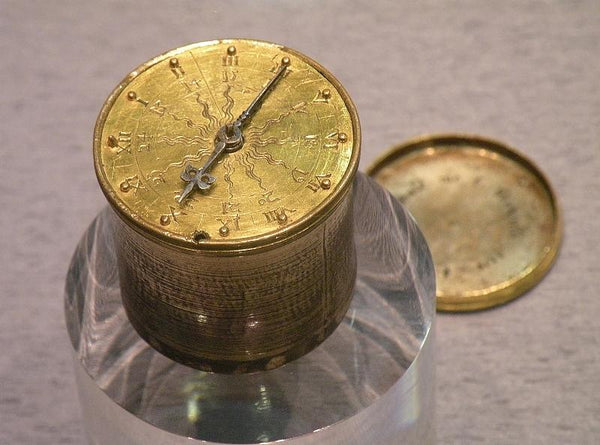
Around 1500, Nuremberg was one of Germany's most innovative cities and home to master locksmith Peter Henlein, who is still credited today with inventing the first watch that could be worn on the body. The masterpiece, dated to 1511, does not have a box shape, however, but the previously popular pomander shape, which is why Henlein probably did not design the Nuremberg Egg at all. But what exactly is a Nuremberg Egg? First things first: it isn't egg-shaped at all but resembles a small box.

It is assumed that the Nuremberg Egg owes its name to the word "Eierlein" (little egg), which in everyday speech at the time was used instead of "Ührlein" (little watch). The earliest documented references to the box-shaped watch worn on a neck chain date from after Henlein's death, around 1550. But centuries were to pass after the Nuremberg Egg before the first pocket watch with a flat case appeared.
From Bulky Block to Athlete: The Evolution of the Pocket Watch
After the development of the Nuremberg Egg, quite a few years would go by before the next milestone in the history of watchmaking was reached. One of the greatest landmarks in horology is undoubtedly the invention of the balance spring in 1658 by Dutch astronomer Christiaan Huygens. Although the innovation initially led to thicker watches, over the following two centuries it made a noticeably slimmer pocket watch possible – together with other advances such as modern gear trains, more compact cylindrical and barrel-shaped springs, and slimmer case constructions.

As precision increased, the hour hand was increasingly joined by a minute hand from 1700 onward and, toward the end of the 18th century, by an additional seconds hand. One of today's oldest brands, Longines, was founded in 1832 and built the first pocket watch in the design that still looks familiar to us in the 21st century. By the time Ferdinand Adolph Lange founded the Glashütte watch industry in 1845, the portable timepiece had essentially reached its final form.

Glashütte: Catalyst of Watch Development
In the second half of the 19th century, the small Saxon town experienced an unprecedented boom. Leading entrepreneurs such as Julius Assmann, Moritz Großmann and Johannes Dürrstein made new watch factories spring up like mushrooms. Dürrstein, who negotiated an exclusive contract to sell Lange timepieces in 1874, founded his own manufacture, Union Glashütte, in 1893 and built spectacular chronometers and tourbillons.
Today, the heritage brand honors the historic achievements of its founding father with the Union Glashütte 1893 Johannes Dürrstein Edition. The founding of the German School of Watchmaking in Glashütte in 1878 accelerated the rise of the watchmaking town by training thousands of new talents, setting the course for the 20th century.


From Pocket to Wrist: The Early 20th Century
One of the school's greatest graduates is Alfred Helwig, who developed the flying tourbillon in the 1920s. His innovation came at a time marked by the biggest upheaval in the history of portable timekeeping: the shift from the pocket watch to the wristwatch. Yet the revolution did not take place in Saxony, where the potential of the strap was recognized too late, but in and above the Atlantic: while Rolex proved its water resistance on the wrist of endurance swimmer Mercedes Gleitze, who spent more than eight hours in the English Channel with the Oyster in 1927, Charles Lindbergh made the first nonstop transatlantic flight that same year. During the adventure, he wore a Longines Hour Angle watch on his wrist. Today, the Heritage watches from Swiss premium brand Longines pay tribute to this pioneering achievement.


Pure Elegance: The Modern Wristwatch Is Born
500 years after the first pocket watch was invented, the form of the wristwatch reached perfection. Just how elegant things already were in the 1930s is demonstrated by the Junghans Meister: still prominently featured in the Black Forest manufacturer's collection today, it was designed in 1936 by "watch architect" Anton Ziegler for clear legibility and understated beauty – principles that remain at the heart of every dress watch to this day.


At the same time, technical progress advanced at a breathtaking pace, as the Mido Multifort, launched in 1934, proves: built to be water-resistant, shock-resistant and antimagnetic, it set the rugged tone for the decades that followed. Its present-day successors, such as the refined Mido Multifort Patrimony, testify to the engineering of this early masterpiece.

The Postwar Era: The Birth of Legendary Wristwatches
After World War II, the watch world developed a design language that still dominates the market today and appears in incredible variety. While dress watches such as the Tissot Visodate developed their flowing forms in the '50s and remain in manufacturers' collections to this day (e.g., the Tissot Heritage Visodate), dive watches reached unprecedented depths and pilot's watches such as the Breitling Navitimer gained worldwide fame. The watch world became more colorful. Grand complications made a comeback, quartz watches shook up the industry from the 1970s onward, and new materials such as ceramic and titanium found their way onto the wrist.


From €100 into the millions, 21st-century horology offers an unprecedented variety of timepieces built for diving, flying, calculating and sometimes simply for looking good. Can our entire fascination with watchmaking as we know it today be traced back to the Nuremberg Egg? In part, certainly. After all, no one knows what our modern timepieces would look like had the first pocket watch been developed in a different form.