« A Living Legend and Its Brands »
"Glashütte – where time lives!" This slogan, coined for the celebrations marking the town's 500th anniversary, perfectly captures what makes this place in the eastern Ore Mountains so special: the small town in the Eastern Erzgebirge, not far from the Elbe metropolis of Dresden, is the center of the German watch industry. Timepieces that have few equals anywhere in the world were and still are created here. We introduce the Glashütte watch brands.
Immerse yourself in the remarkable history of a fascinating home of German watchmaking. We take you on an exciting journey back through the centuries, finally arriving in the present day of this Saxon watchmaking town and its modern watch brands.


Which Glashütte watch brands still exist today?
First things first: to this day, numerous watch brands are based in the Saxon town of Glashütte. The best-known watch brands of the watch town are MÜHLE Glashütte, NOMOS Glashütte, Glashütte Original, as well as Bruno Söhnle and Union Glashütte.

Milestones in Glashütte's history
On February 10, Glashütte (according to records, glassworks briefly operated here around 1400) is granted its town charter by Duke "George the Bearded." For three centuries, it is not watch brands but mining that shapes the little town, until the ore deposits gradually run dry in the early 19th century. Straw weaving and farming yield little as well, and the region falls into poverty.

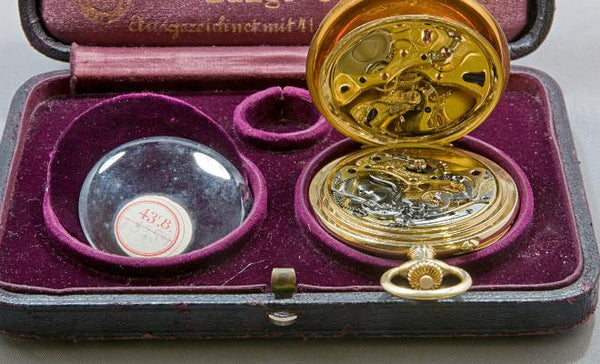
In 1845, the local watch industry is born. Its most important midwife is Ferdinand Adolf Lange (1815–1875), who some years earlier had attended the "Technische Bildungsanstalt zu Dresden," founded in 1828, and learned the watchmaking trade under Johann Christian Friedrich Gutkaes (1785–1845; at the time royal court watchmaker). After his training, he set off on extended journeyman travels that took him, among other places, to Switzerland's Vallée de Joux, the famous "valley of watchmakers" not far from Geneva. There he discovered the typical Swiss production method known as the putting-out system, in which watchmakers source the individual components for their watches from various outside firms, each specializing in watch parts, tools, or measuring instruments. Finally, the watches assembled from these components are also sold by the so-called "établisseur."

Armed with his newly acquired knowledge, F. A. Lange returned home and negotiated a loan with the Saxon government that allowed him to realize his dream of a homegrown watch industry in Glashütte modeled on the Swiss example. On December 7, 1845, he lays the foundation for all of the small town's later watch brands. Lange and his associate Adolf Schneider (1824–1878; likewise a former student of the Technische Bildungsanstalt zu Dresden and apprentice of J. C. F. Gutkaes) begin training the first 15 apprentices. Just 36 months later, some of them set up on their own: they manufacture the required watch parts and supply them to their master, F. A. Lange.
A hallmark takes the world stage
In 1851, F. A. Lange ventures onto the international stage with his watches for the first time. He presents his precision watches at the Great Exhibition in London and earns wide acclaim – especially among the English and North Americans. It is no surprise, then, that F. A. Lange returns home with full order books and brings worldwide fame to the name Glashütte.

In the years that follow, many more watch brands emerge in the small town. Particularly noteworthy are those of Julius Assmann (1827–1886) and Carl Moritz Grossmann (1826–1885), both supported by F. A. Lange. J. Assmann founds his company in 1852. His pocket watches win numerous awards at national and international exhibitions. Two years after J. Assmann, C. M. Grossmann opens his factory, which specializes in toolmaking. It also produces escapement models and fine pocket watches. The development of Glashütte's precision pendulum clocks and chronometers is likewise largely due to Grossmann's work. In 1855, A. Schneider, until then F. A. Lange's associate, establishes his own watch manufacturing business.
The Union Glashütte watch brand is founded
The year is 1874. Merchant Johannes Dürrstein (1845–1901) negotiates an exclusive contract with F. A. Lange to distribute the watches from Lange's manufacture. The partnership brings great success to both parties. Nevertheless, J. Dürrstein decides to open his own watch manufacture in 1893. It is called Union and produces simple pocket watches, pocket chronometers, and complex pocket watches with tourbillon. By way of explanation: the tourbillon (French for "whirlwind") is a special mechanism designed to compensate for rate errors caused by gravity.


German School of Watchmaking
Given that watch brands had their beginnings in Glashütte, it is only logical that the "Deutsche Uhrmacherschule" (German School of Watchmaking) is founded there in 1878. C. M. Grossmann acts as initiator, while the Central Association of German Watchmakers is in charge of implementation. The apprentices are taught in rooms of the municipal schoolhouse. As student numbers rise rapidly – and thanks to the immense support of the state government, the municipality, and a foundation – the new watchmaking school is inaugurated in 1881 in the building that today houses the town's "German Watch Museum." By 1951, more than 4,000 watchmakers and precision mechanics are trained here. For the following 40 years, the building is home to the "School of Engineering for Precision Technology." Today, in addition to the museum mentioned above, the historic building also houses the "Alfred Helwig" watchmaking school, which provides apprenticeship training for the Glashütte Original manufacture.


Every watch here is an original
In 1918, several watchmakers join forces to found the "Deutsche Präzisions-Uhrenfabrik e.G.m.b.H." (DPUG). The goal of this production cooperative is to manufacture pocket watches as affordably as possible. From then on, the timepieces are produced under the registered trademark "Original Glashütte." From 1921, this mark on the dial is the seal of quality craftsmanship from the town, setting it apart from imitations by other watch brands bearing inscriptions such as "System Glashütte." Today, in line with the regulations, wristwatches made in the watch town are marked "Glashütte/SA." The inscription symbolizes many centuries of craftsmanship and is inseparably linked with the great prestige of the Saxon watchmaking center.
Years of crisis for the watch brands
In the 1920s, the Glashütte watch brands face decline. The causes are inflation, the Great Depression, and the failure to switch to wristwatch production. To avert disaster, the Giro-Zentrale Sachsen steps into the breach: it finances the founding of two new companies – in 1926, the "Deutsche Uhren-Rohwerkefabrik Glashütte" (Urofa) and the "Uhrenfabrik Glashütte AG" (Ufag) are established. Urofa becomes the first Glashütte company to manufacture its own wristwatch movements, firing the starting gun for the development of various wristwatch calibers.

Shortly before the end of World War II, on May 8, 1945, the town is bombed – and some of the watch manufactures are destroyed. But the watchmakers refuse to be defeated by the difficult circumstances and quickly begin rebuilding watch production.
A fresh start as a watchmaking collective
In the eastern part of divided Germany, there is little room for a diversity of watch brands. Watch brands as cult objects, trend products, or lifestyle statements no longer exist; manufacturers are merged. In 1951, all of the town's remaining watchmakers are combined into the "VEB Glashütter Uhrenbetriebe" (GUB). Until German reunification, the factories create a wide-ranging assortment of wristwatches and instruments. On October 16, 1990, the "Glashütter Uhrenbetrieb GmbH" emerges from VEB Glashütter Uhrenbetriebe. It creates the Glashütte Original watch brand.

Something else remarkable happens in 1990: on December 7 – exactly 145 years to the day after F. A. Lange founded the Glashütte watch industry – his great-grandson Walter Lange registers "Lange Uhren GmbH" as a new company. Today, the company's wristwatches once again rank among the very best that international watchmaking has to offer. And further Saxon watch brands emerge.
Let's jump to 2006. Five hundred years earlier, the town had received its charter. Now the town and the Glashütte Original manufacture establish the "Stiftung Deutsches Uhrenmuseum Glashütte – Nicolas G. Hayek" (German Watch Museum Glashütte Foundation – Nicolas G. Hayek). It promotes science and research, art and culture, and education in the field of watchmaking. Finally, in 2008, the German Watch Museum opens in the building into which the German School of Watchmaking had moved almost 130 years earlier. The museum's motto is "Fascination of Time – Experience Time." Here you encounter the tradition of watchmaking and gain an emotional connection to the phenomenon of time.
Glashütte's watchmaking magic today
The legend of the watch town lives on to this day. Current watch brands with a great history, such as Nomos, Union, Glashütte Original, Bruno Söhnle, and others, continue to produce modern pieces of select watchmaking artistry for women and men there.
The watch brands take different approaches. Bruno Söhnle, for example, crafts elegant women's and men's watches with classic references, but is also committed to continuously refining a purist aesthetic. With a decidedly feminine touch, diamonds and diamond-set bezels adorn Bruno Söhnle's refined women's watches. Nomos, too, focuses primarily on classic, understated designs paired with the highest degree of horological functionality, visibly combining traditional craftsmanship with high tech. The same applies to the products of the Union manufacture, once founded by J. Dürrstein. The "Glashütte Original" inscription appears on timepieces that showcase every facet of German manufacturing. The manufacture unites all the qualities that have distinguished the town's unique history in connection with time from the very beginning: determination and perseverance, precision and refinement, quality and beauty.


In the heart of Saxony, time lives – it did centuries ago, it does today, and it surely will in the future! Discover numerous watch brands from Glashütte in our shop.