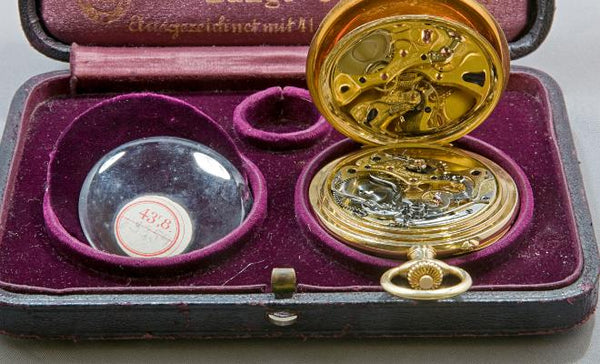
“A Glashütte Original”
Watchmaker, entrepreneur, legend: Glashütte’s rise to become one of the most famous towns in horology is inseparable from the name Julius Assmann. Starting in the mid-19th century, his Deutsche Anker-Uhren-Fabrik created internationally renowned timepieces that became synonymous with the highest quality standards and pure luxury. Today, more than 130 years after the pioneer’s death, his traces are still visible in the Saxon watch industry.
The Beginnings: From Mining to Watchmaking
Just like many modern-day musicians, athletes, or actors, Julius Assmann started his career at a young age: born in Stettin in 1827, he turned to his passion for mechanical construction at 16 and decided to apprentice as a watchmaker with a local master. He then furthered this training in Berlin, where he deepened his expertise as an assistant to a chronometer maker.
Assmann’s ambition paid off in 1850, when he successfully applied to work for one of the greatest watchmakers of his day. His name: Ferdinand Adolph Lange.
Known today mainly as the founder of the heritage brand A. Lange und Söhne, revived in 1990, Lange laid the foundation in 1845 for what would later become the thriving watch industry of the small Saxon town of Glashütte. In doing so, he fulfilled the wish of the Royal Saxon government, which wanted to transform the town – shaped by mining for centuries – into a center of timekeeping and backed Lange with substantial start-up funding. Despite early difficulties, the Dresden-born entrepreneur succeeded in concentrating the expertise of German watchmaking in this unassuming town, creating fertile ground for young talents like Assmann.
 An Entrepreneur at 25: The Fall and Rise of Julius Assmann
Lange soon realized that in the gifted young man from Stettin he had hired not just any watchmaker, but an exceptional talent. After only two years of employment, he advised Assmann to start his own company and offered him financial support for the venture.
An offer the 25-year-old employee simply couldn’t refuse.
In 1852, he founded his own business under the name “Deutsche Anker-Uhren-Fabrik,” initially specializing in the research and development of new movements. What looked promising gradually turned into a financial disaster. Although the young entrepreneur had numerous components produced during the training of new skilled workers, he was unable to assemble them into complete watches.
On top of that, every loan request to the Saxon state government was rejected, so that seven years after its founding, the new company was on the verge of collapse.
Only a request from Adolph Lange, with whom Assmann still maintained a close relationship, secured approval of the loan – paving the way to decades of success not only for the Deutsche Anker-Uhren-Fabrik, but for the entire Glashütte watch industry.
Peak Years and International Success
This golden era was kicked off by a true classic of the Saxon town: the Glashütte precision pocket watch, still famous today. First completed in 1865, it was created as a collaboration between Assmann, Lange, and the equally renowned manufacturers Moritz Großmann and Adolf Schneider.

This joint project paid off twice over: it sold like hotcakes in the wealthy British colonies while also strengthening Glashütte’s position against the Swiss watch industry. But even on his own, Julius Assmann became a respected figure in his field, his timepieces standing for outstanding reliability and precision – numerous international awards, such as from the London Industrial Exhibition, attest to this success. While his market was initially almost entirely abroad, the glorious “Gründerjahre” (founding years) from the 1870s onward also brought notable sales in Germany.
Fortunately, the pioneer’s eldest son, Paul, shared his passion for delicate masterpieces. He trained as a watchmaker in the family business and in Le Locle, Switzerland, and carried on his outstanding father’s company after his death in 1886. It was that very year that Alfred Helwig, another genius of Glashütte’s watchmaking history, was born.
Ready for the Mass Market

Toward the end of the 19th century, Paul Assmann faced an entirely new challenge: while pocket watches had previously been reserved for a predominantly wealthy clientele, demand was now rising rapidly among the middle class as well. Together with Frederick Gruen, son of the American watch entrepreneur Dietrich Gruen, he therefore founded the “Grünsche Uhrenfabrikation Grün und Assmann” in 1894, which existed alongside the established company. By combining Glashütte expertise with the American template system – a method for producing large quantities more easily – they achieved an impressive annual output of around 2,000 pieces.
Until Paul Assmann’s death in 1911, his companies enjoyed extraordinary success, marked by ties to the American market, new partners, and the production of high-end complications such as perpetual calendars, minute repeaters, and split-seconds chronographs.
No doubt about it: the modest workshop of 1852 had become an internationally active company.
What Remains: The Master’s Legacy
World War I and its devastating aftermath brought an abrupt end to the Deutsche Anker-Uhren-Fabrik, by then owned by entrepreneur Georg Heinrich: after the business was first sold to a Thuringian group, it was liquidated in 1926, marking the end of the manufacturer. All attempts by Fritz Assmann, Paul Assmann’s son, to revive the Glashütte company up until 1930 failed.

So is Julius Assmann nothing more than a matter for the history books today? One of many careers that left no lasting mark? Any Glashütte enthusiast will shake their head at the mere question. Because the pioneer’s legacy ranks among the greatest in modern horology.
Besides decades of developing the pocket watch and steadily refining it into a reliable precision instrument, the German School of Watchmaking also owes its existence to Assmann’s achievements. Together with Lange and other notable figures of the town, he founded the academy that produced countless master watchmakers from 1878 to 1992.


Small wonder, then, that Glashütte Original has honored the innovative entrepreneur several times with high-end models such as the “Julius Assmann 4”: with its tourbillon and skeletonized design, this spectacular model represents the pinnacle of watchmaking, just as its namesake ranks among the most prominent figures in horology.
May Assmann’s life’s work never be forgotten, and may the once again thriving watch town – with brands like Nomos, Mühle, Union Glashütte, and Bruno Söhnle – help preserve the watchmaking pioneer’s legacy.