“When was my watch made?”
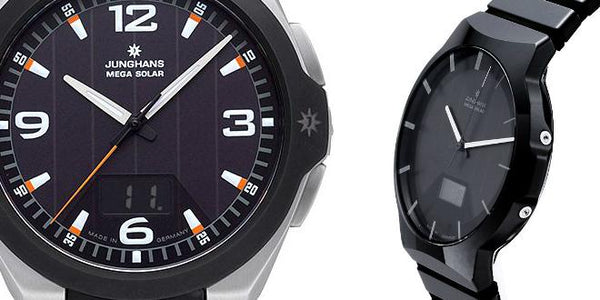
With its wide range of models, elegant designs, and broad price spectrum, Junghans ranks among Germany’s most popular watch brands. Not only new releases but historical editions, too, sit on many enthusiasts’ wish lists – and frequently raise the question of when they were made. We explain which approaches matter for successfully dating a watch and give an overview of the popular manufacturer’s model history.
1928: The first wristwatches appear
The Black Forest brand was founded in 1861, when Erwin Junghans began producing clock components for the local industry. Initially specializing in parts for larger clocks such as wooden cases, glass doors, and pendulum discs, the manufacture built its first clocks of its own in 1866.
What started big became ever more compact over the following decades: in the 1870s, alarm clocks joined the Schramberg lineup, followed shortly before the turn of the century by pocket watches.
It wasn’t until 1928 that the manufacturer began producing wristwatches – initially with sourced calibers, and from 1936 onward with in-house movements.
Dating by caliber
Those in-house movements play a key role in dating Junghans watches and often allow the production period to be narrowed down closely. As a general rule, every caliber with the prefix "J" was made before the 1962/63 model year, while most other movements date from the period after.
Among the most important movements of the early period is the J80, which was fitted to the first wristwatches from 1936 and, in its most elaborate version, called "Meister," bears the designation J80/2.

After World War II, during which the company was converted to armaments production, the J88 chronograph caliber continued the brand’s military history with the Bundeswehr. Introduced in 1946, it was produced until 1964 and powers many of the manufacturer’s classic pilot’s watches.
From 1950, the "civilian" J82 caliber was added, only to be overshadowed in 1957 by the famous J83: as the manufacturer’s first automatic chronometer movement, it powers some of today’s most sought-after collector’s pieces and was built through 1964. If, on the other hand, you come across the caliber name J85 while dating your Junghans, your timepiece is, on average, somewhat more recent; it was produced between 1960 and 1967.
Although this list is far from covering every movement of the "J" era, it shows just how useful mechanical movements are for dating a watch. Freely available caliber tables online are an excellent way to find out more about when your own timepiece was made.
Serial numbers as a key factor
Since the naming system changed in 1962/63, every caliber designation begins not with the letter J but with a digit – usually a 6 –. One example is 687.11. Often, however, the mechanical movement alone does not allow a Junghans watch to be dated precisely – after all, most calibers were produced over several years. That is why it pays to check the serial number: as with most other brands, extensive, freely available tables for dating your timepiece can be found online.
If a closer look at these tables doesn’t help, we recommend contacting the Schramberg manufacturer directly. An archive extract usually comes with a fee at most brands, but it provides reliable confirmation of the timepiece’s provenance.
Electronic features and modern collections
Junghans’ more recent history is marked by a series of electronic innovations. In 1970, for instance, the "Astro-Quarz" appeared as a pre-series of the first German quartz wristwatch. Powered by the W666.02 caliber, it went into series production in 1972 and laid the groundwork for further modernization of the product portfolio. Such as in 1990, when the Black Forest brand presented the world’s first radio-controlled wristwatch, the Mega 1.
1993 saw the introduction of the first solar watches, followed by the first time signal transmitter in 2004. With more modern editions like these, dating is usually much easier than with vintage series – a look at the design, features, and name is often enough to pinpoint them precisely.
More tips for dating Junghans watches
Experienced collectors know that caliber, serial number, and model line are far from the only factors in dating a watch. A timepiece’s exterior reveals more about its year of manufacture than you might think. Take the luminous paint on the dial: until the early sixties, the hazardous substance radium was often used before being replaced by tritium. Many timepieces indicate this detail with a small "T" next to the country-of-origin marking.


Certain trends, such as case materials, also offer clues to a watch’s age – many models from the 1930s are made of "nickel-chrome," for example, while later series from the ’40s increasingly relied on stainless steel. Any engravings on the case – whether logos, inscriptions, or brand names – are likewise specific to certain periods and can be classified fairly quickly by experts.

If you’d rather not go to a jeweler right away, forums often offer valuable advice. This route has the best chance of success if you gather as much information as possible on your own beforehand.
Conclusion: There are many starting points
Caliber, serial number, technology, and design: when it comes to dating Junghans watches, many roads lead to the goal. If freely available information isn’t enough, experts, jewelers, or the manufacturer can help you find the right year of manufacture. A major advantage with Junghans is its clearly defined company history: the pre-war era, the period of the J calibers, and the subsequent introduction of many technical innovations allow for a precise search for the year your own masterpiece was made.