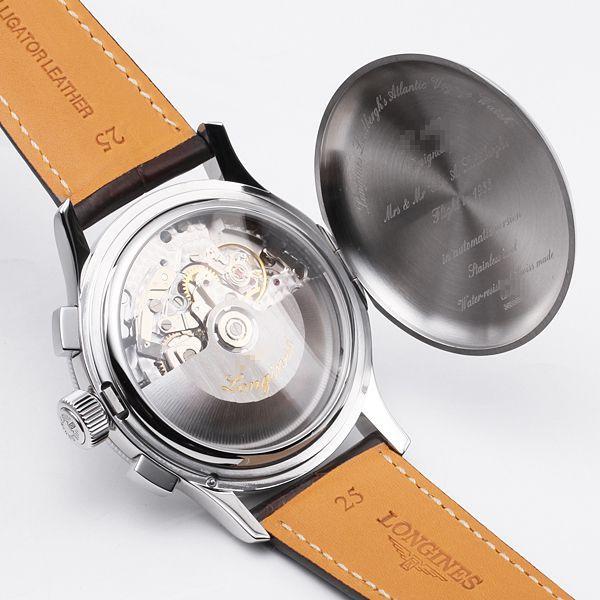
Paris, May 21, 1927: Charles Lindbergh makes history with the world's first nonstop transatlantic flight. Shortly afterward, the legendary aviator teams up with Longines to develop the Lindbergh Hour Angle Watch, one of the most famous pilot's watches of all time. Designed for long-distance flights, it lets you calculate longitude quickly and simply right on your wrist. Today, the timepiece known as the Hour Angle is part of the Swiss manufacturer's Heritage Collection and brings Lindbergh's daring achievements within reach.
33 Hours over the Atlantic
The origins of the Hour Angle Watch could hardly be more closely tied to the famous Atlantic crossing by the aviator, born in 1902. Lindbergh, the son of Swedish immigrants, witnessed the dawn of aviation as a young man and gained his first cockpit experience with the U.S. Army. Skills he would need more urgently than ever on the morning of May 20, 1927:
Loaded with more than 1,700 liters of fuel and powered by a single engine, his spartan high-wing monoplane, the "Spirit of St. Louis," took off from Roosevelt Field in New York bound for Paris. Because the enormous fuel tank blocked his forward view, Lindbergh could only fly by sight through a periscope during the 33-hour flight.
Despite all the hardships, the adventure ends in triumph: the world is enthralled, and the pilot becomes a hero. Charles Lindbergh walks away not only with the prize money of $25,000, a huge sum at the time, but also with the Medal of Honor.
From Sketch to Success: The Lindbergh Hour Angle Watch
What we know for certain is that, during his flight, the adventurer used a wristwatch to determine his position - alongside a compass and an airspeed indicator –. The model remains unknown to this day, but it can't have been particularly satisfactory: in early 1931, he sent a sketch of his own pilot's watch to John P. V. Heinmüller, president of Longines' American division.

Lindbergh's inspiration was the Weems Navigation Watch, developed in 1927 by naval officer and navigation instructor Philip van Horn Weems and regarded as the first pilot's watch in history. Its rotating central sub-dial served as the model for the mechanism intended to allow precise longitude determination in Lindbergh's design. For Heinmüller, Lindbergh's ideas were a gift:
In the early 1930s, the aviator was a superstar whose name alone was enough to guarantee marketing success. Just five months passed between the sketch and the first production run of the Hour Angle Watch in the summer of 1931. Demand was strong: nearly 5,000 pieces were sold to pilots and airlines in the first few years.
Beyond its innovative longitude calculation, the Hour Angle also boasted solid mechanics, with a movement that achieved high precision thanks to a Breguet overcoil hairspring. In 1938, the 47 mm powerhouse received a new caliber, but the winning formula of an oversized crown and outstanding legibility stayed the same. Today, a well-preserved example of the original 1930s Longines Lindbergh Hour Angle Watch often commands a five-figure sum.
The Return of a Collector's Piece
From the 1940s onward, navigation technology advanced so rapidly that the Lindbergh Hour Angle Watch became obsolete. It disappeared into the history books, where it would remain for more than four decades.
Then, in 1987, the classic made its big – or rather, small – comeback: at just 38 mm, it matched the typical diameter of men's watches of the day and became a popular accessory from the Swiss brand.
In 1990, enthusiasts could celebrate the return of the "true" size of 47.5 mm - the new version featured a historical hand-wound movement and, typical of the nineties, a gleaming yellow gold case.
In 2007, for the 80th anniversary of Lindbergh's flight, the Swiss designers again opted for a special edition in a gold case. 2017 brought the 90th Anniversary Edition: limited to just 90 pieces, this black-and-white reissue is, in our opinion, the most successful of all the tributes to date.
The Classic Today: The Lindbergh Hour Angle Watch
After a long production history with many interruptions, the Hour Angle Watch is now a permanent fixture in the Longines Heritage Collection.
Its members – which also include re-editions of the Weems Navigation Watch and the famous Skin Diver – are considered by experts to be among the best and most authentic vintage-inspired models in the industry.


In the case of the modern Hour Angle, this means combining original elements with modern technology: the 47.5 mm diameter has been retained, while the automatic caliber L699 offers a 46-hour power reserve and significantly better precision than its forebear.
The Roman numerals have been kept as well, but unlike the original, blue and red accents now give it a more appealing look. Blued hands, scratch-resistant sapphire crystal, and a sapphire caseback make the new Lindbergh Hour Angle Watch even more attractive.
No Middle Ground for the Hour Angle
When it comes to functionality, there are no compromises. Then as now, the pilot's watch features a rotating central sub-dial for synchronizing the seconds hand with an external radio time signal, ensuring maximum precision when calculating longitude.
The bidirectional rotating bezel serves the same goal: it compensates for the daily variations in the equation of time, accounting for the difference between mean and true solar time.
We explain the complete, detailed workings of the Hour Angle Watch in a separate article. If you're interested in buying this exotic reissue, the manufacturer says you'll need to set aside €4,150. Certainly no bargain, but you won't find more aviation history on your wrist.