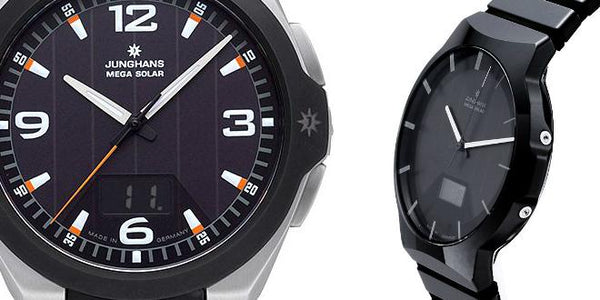
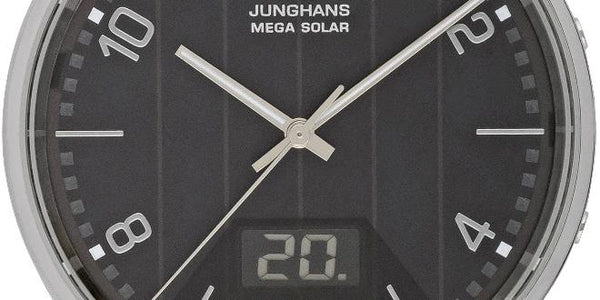
Luxury watches don't necessarily have to be powered by a mechanical movement. In fact, there are watchmakers in the luxury segment that deliberately rely on modern electronics and other advanced technologies to achieve the highest possible precision while ideally also minimizing resource consumption. One example is the Junghans Solar and radio-controlled watch range, which is the focus of this article.
A Successful Founder on the Second Attempt
The oil mill that merchant Erhard Junghans founded in 1860 in the small Black Forest town of Schramberg together with his brother-in-law Jakob Zeller-Tobler soon proved to be a commercial failure. But what was an unpleasant setback for the two founders at the time is something many watch enthusiasts today would likely regard as a happy twist of fate.


After all, had Junghans become successful and wealthy as an oil mill operator, the watch brand that still bears his name today would hardly exist. With it, the enterprising merchant and his brother Xaver made a second attempt at founding their own company in 1861 – and this time with lasting success.

While they initially made only case parts for other Black Forest clockmakers, by 1866/67 they were already able to move on to producing their first movements. In 1870, daily output still amounted to around 60 timepieces, but by 1903 the company, now employing more than 3,000 people and producing over three million timepieces a year, had risen to become the largest watch and clock manufacturer in the world. This rapid growth was due in no small part to the numerous technical modernizations that the second generation at the helm of the family business had implemented in the meantime, many of them strongly inspired by technological developments in the USA. At the time, the product range included wall clocks, table clocks, and pocket watches, but not yet wristwatches.
From Former World Market Leader to Technology Pioneer
It was not until 1928 that the Schramberg factory – which had used a five-pointed star as its logo since 1888 and an eight-pointed star with a "J" in the center since 1890 – also began making wristwatches.
While these initially used movements bought in from the Thiel brothers of Ruhla, Junghans wristwatches were fitted with in-house calibers from 1930 onward. After the Second World War came a dramatic turning point when the French military administration had major parts of the production facilities dismantled and shipped to France. Nevertheless, the Schramberg watchmaker managed to resume civilian watch production as early as 1946.


By then, however, the position of world market leader in watch and clock production that Junghans had achieved at the beginning of the 20th century – at least in terms of volume – had long since passed to other brands. Schramberg therefore now focused primarily on producing high-quality watches and harnessing new technologies.


One of the most spectacular results of these research and development efforts was a radio-controlled table clock unveiled to the public in 1986. It was one of the very first commercial radio-controlled clocks anywhere in the world.
The 1990s: From Junghans Radio Control to Junghans Solar
The Black Forest brand quickly followed its first radio-controlled clock with others, and radio-controlled models still hold an important place in its lineup today. The digital MEGA 1 of 1990 was the world's first radio-controlled wristwatch. It was followed a year later by the first radio-controlled model with an analog display, designed by frog design.
The next technological quantum leap came in 1995 with the MEGA Solar Ceramic, which combined radio control, solar power, and a case made from an innovative ceramic material.
Since then, solar watches have been as much a natural part of the Junghans lineup as radio-controlled watches.
With the first multi-frequency radio-controlled wristwatch in 2004, the company vastly expanded the range of use of its watches, as they could now receive and process not only the signals of the European time signal transmitter DCF77 but also those of JJY in Japan and WWVB in the USA.
One of its most recent achievements is the J101 movement, also radio-controlled, which was first presented in July 2018 and makes it possible to build radio-controlled watches with a classic watch design.
Remarkable Technological Diversity: A Look at the Current Collection
Today, the Junghans lineup stands out for its remarkable technological diversity, ranging from hand-wound mechanical models and automatic watches to combined radio-controlled solar watches. One of the flagships of the current collection is undoubtedly the new Junghans Meister Mega. In terms of design, it looks like a classically elegant dress watch, yet it is equipped with modern technology.
It features automatic transmitter search via the patented Autoscan, a perpetual calendar that works reliably until the year 2400 even without a radio signal, and an intelligent time correction function that checks 1,140 times a day whether the seconds hand is in the correct position or needs to be corrected. Smart Hand Motion ensures precise seconds display in half-second steps, and the Advanced Moving Function ensures that the minutes and date advance exactly. A dedicated app, available for both Android and iOS, makes it possible to synchronize this special Junghans radio-controlled watch even when it has no radio reception.
Junghans Radio-Controlled & Solar: From Max Bill to Force and Spektrum
If you prefer a more modern, "technical" look, the "Radio-Controlled & Solar" collection offers a selection of suitable models with the Force, the 1972 Chronoscope Solar, or the Spektrum for women. The collection named after Max Bill also includes several radio-controlled Junghans models. They combine the classic Bauhaus design characteristic of Max Bill with modern radio control.
Especially against the backdrop of current discussions about reducing emissions and cutting resource consumption, a watch like the Junghans Solar feels particularly relevant. It is therefore quite possible that in the coming years the brand will succeed in winning over not only fans of alternative luxury watches but increasingly also younger customers for its Junghans Solar and Junghans radio-controlled watches.