« When the Black Forest Went Mega »
The Junghans Mega Solar is a watch that represents an important milestone, and not only in the history of its brand. It combines cutting-edge watch technology with a solar-powered drive. That is not just environmentally friendly but also extremely convenient for the wearer, who never has to think about winding, power reserve, or battery life. In the following article, we take a closer look at the watch legend that is the Mega Solar.
One of the Most Innovative Watch Companies in the World
The German watchmaker Junghans looks back on a remarkable company history. At the beginning of the 20th century, with an annual output of more than three million watches and clocks, the company was the largest watch producer in the world by volume. Although it no longer holds the position of market leader today, it remains one of the most innovative watchmakers worldwide.
The Mega Solar and the story of its development demonstrate this especially well.
The models sold under this name today, which belong to different model lines in terms of design, bring together several innovations associated with the Junghans name. They are fitted with a solar-powered quartz movement that also features multi-frequency radio control.
Top-Tier Watch Technology from the Radio-Controlled Pioneer
In radio-controlled watch technology in particular, the brand with the distinctive star logo still enjoys an especially strong market position, rooted in the company's leading role in the relevant technical developments. As early as 1986, Junghans launched a radio-controlled clock that was among the world's first commercial radio-controlled timepieces.
That was still a desk clock rather than a wristwatch, but just four years later Junghans introduced the Mega 1, the world's first radio-controlled watch that could be comfortably worn on the wrist.
With its case designed by frog design, the Mega 1 made watch history not only technically but also in terms of design. In 1995, the model line once again caught the attention of the industry and watch enthusiasts when it was equipped with an eco-friendly solar drive. This technical innovation was paired with a ceramic case. Thus the Mega Solar Ceramic was born, and it, too, brought its maker impressive commercial success.
Produced in Both Digital and Analog Versions
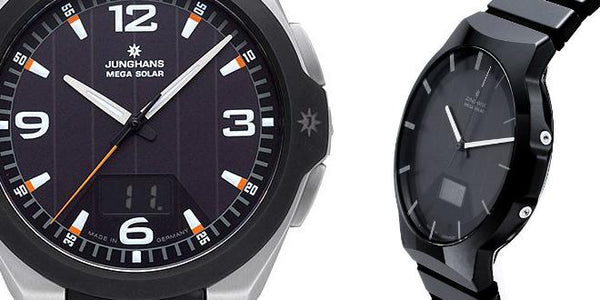
The new technologies were used in both digital and analog watches, and Junghans watches frequently combine the two. The Mega 1 had a digital LCD display, whereas the 1991 Mega went down in history as the first analog radio-controlled wristwatch, yet it also featured an LCD display in the upper part of the dial to show the date and day of the week. The first radio-controlled solar wristwatch of the Mega line, by contrast, was an analog watch that did have a small digital display window at 6 o'clock, but it was considerably smaller than on the 1991 model and clearly subordinate to the analog dial design with its simple baton indices.
And although it is now more than two decades old, the design of the 1995 Mega Solar Ceramic looks so timeless that it could easily come from a current watch collection.
Ready for a Sunny Future
In recent years, too, Junghans has developed technological innovations that equip the renowned model line for the challenges of the future. Since 2004, for example, solar-powered multi-frequency radio-controlled wristwatches have been available. These can receive signals from time-signal transmitters in Europe, Japan, and the USA. This overcame a shortcoming of early radio-controlled models, which could only be used within the area covered by the particular time-signal transmitter whose signals they were designed to receive.


The manufacturer's current lineup includes several watches that carry the now-famous Mega Solar name and offer their wearers the precision of a radio-controlled watch combined with the eco-friendliness and efficiency of solar technology.


Because the individual models belong to different design lines, however, you can choose between sporty, classic, and retro designs. There is, for example, the Junghans 1972 collection, which recalls the Olympic year in which the Black Forest company served as official timekeeper. It is a sporty stainless steel model with a slightly cushion-shaped case, a style that was very popular in the late 1960s and the 1970s. For women, there is a timelessly elegant version with a perfectly round stainless steel case and an elegant leather strap from the Junghans Milano series.


And the Junghans Force collection includes a model with a mysteriously gleaming black ceramic case and bracelet.
Solar Power with Impressive Efficiency
Whichever of these models you choose, you get a highly precise, carefully crafted watch with impressive energy efficiency. When the solar watch is not in use, it switches into a kind of sleep mode after 72 hours. Its power reserve in darkness is up to 21 months. Only then does the watch absolutely need to be exposed to sufficient light again to keep it from stopping.


In practice, however, the solar drive's capabilities are unlikely to be pushed to their limit very often in this respect – after all, who would want to leave such an impressive watch sitting in a drawer for months?