« Precise Timekeeping Powered by Light »
Clever, precise, and modern: solar radio-controlled watches rank among the most advanced timepieces in the industry, managing to combine two smart technologies in slim cases. While radio control achieves extreme accuracy through regular synchronization, solar technology scores with a virtually inexhaustible energy supply. Read on to find out how a solar radio-controlled watch works, what its advantages and disadvantages are, and why a German brand leads this niche.
How Do Solar Radio-Controlled Watches Work?
To understand how solar-powered radio-controlled watches work, you need to look at the radio and solar technologies separately. Let's start with the power supply: at the heart of the system are its solar cells, which generate electricity when exposed to light and feed it into a rechargeable battery rather than sending the energy directly to the movement. Quartz calibers are used.
The rechargeable battery provides a power reserve in darkness, meaning the length of time the movement can keep running without any new light. Modern watches achieve up to two years of power reserve in darkness – an enormous feat. From the battery, current flows into the quartz movement, where it sets small gears in motion and keeps the watch running. A quartz crystal regulates the flow of current between the battery and the quartz movement. The solar radio-controlled watch gets its accuracy from a time signal transmitter that broadcasts the current time as a radio signal. There are currently 24 such transmitters worldwide; the only one in the German-speaking region is located at Mainflingen near Frankfurt am Main.
To save power, the signal isn't received continuously but typically every few hours. Many modern solar radio-controlled watches have a power-saving mode that stops the hands after an extended period of darkness while timekeeping continues in the background, ensuring the watch is ready for use instantly on demand.
Solar Radio-Controlled Watches: Pros and Cons
If you're looking for maximum precision and modern technology at an affordable price, a solar radio-controlled watch is an excellent choice.
[box type="note" align="" class="" width=""]Because of their quartz technology, these modern instruments lack the mechanical charm of an automatic or hand-wound watch – though for many wearers, that's no drawback at all.[/box]High-quality radio-controlled watches with solar technology do command a noticeable price premium over conventional quartz watches, all else being equal, but in return they deliver ultimate convenience: first, you never have to adjust the time (including for daylight saving time changes), and second, no battery replacement is needed, which regular quartz watches require every two to five years. On top of that, the rechargeable battery has an extremely long average service life, running for up to 40 years straight in high-quality solar radio-controlled watches. We find that impressive.
Which Brands Make High-Quality Models?
One popular solar radio-controlled watch right now is the Tissot Connect Solar, although as a smartwatch it represents a special case.


In the more classic segment, alongside Japanese pioneers such as Seiko and Citizen, one brand stands out above all: Junghans. Ever since the Black Forest company presented the first electromechanical table clock in 1962, experts have regarded it as a pioneer of electronic timekeeping. In 1970 came the Astro-Quartz, the first German quartz wristwatch, followed by official timekeeping at the 1972 Summer Olympics in Munich. In 1986, the manufacturer unveiled the RCS1, the world's first radio-controlled solar clock – a stationary tabletop model.
[box type="info" align="" class="" width=""]It didn't take long for this clever technology to reach the wrist: in 1990, the Schramberg manufacture launched the MEGA 1, the first solar radio-controlled watch for everyday wear.[/box]Pure Sportiness: The Junghans Spektrum Collection
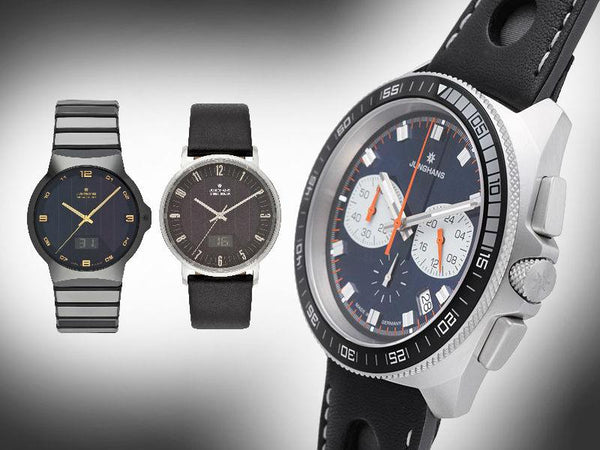
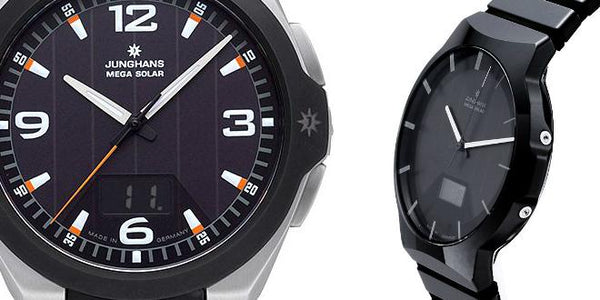
Today, this groundbreaking technology can be found in many of the brand's collections. The sportiest line is called Junghans Spektrum and features a high-contrast two-tone design that pairs a stainless steel case with a scratch-resistant ceramic bezel. The ceramic continues in the center links of the bracelet, creating a seamless look.

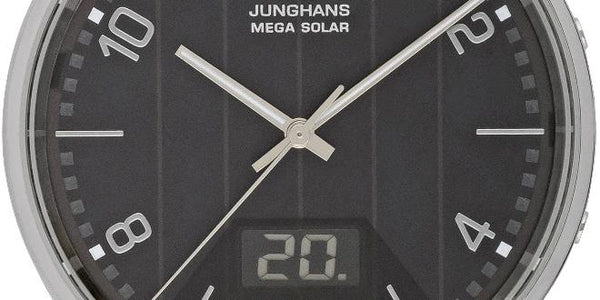
The presence of this all-rounder, water-resistant to 100 meters, shouldn't be underestimated: a 41.6-millimeter diameter is ideal for medium to large wrists, while a height of 9.6 millimeters keeps it pleasantly understated. Visually, the watch is down-to-earth: applied Arabic numerals and strong contrasts make for excellent legibility. The Spektrum isn't short on cool features either: besides the digital big date at 6 o'clock, the pusher lock on the right side of the case catches the eye, blocking the time zone button whenever you want.


These solar radio-controlled watches draw their power from the multi-frequency radio-controlled solar movement J615.84, which offers a generous 21-month power reserve in darkness and switches the Spektrum into sleep mode after 72 hours. Once sleep mode is activated, the watch makes no attempts to receive the nearest time signal transmitter and instead continues keeping the current movement time on a quartz basis.
Futuristic Design in Full Ceramic: The Force Series
Another special feature of the movement is its smartphone connectivity: with the Junghans Mega App for iOS and Android installed, you can set the time on the watch manually. The J615.84 is also used in the Junghans Force collection, which, unlike the Spektrum, focuses on futuristic elegance with a full ceramic case. Flatter, slimmer, and more graceful – if you want to experience solar radio-controlled watches at their most refined, you'll love the slim 40.4-millimeter Force, just 8.2 millimeters thick.


The price of this beauty is water resistance of 50 rather than 100 meters, which shouldn't bother most wearers. In the hierarchy, the series sits slightly above the Spektrum, as fine details such as the titanium rather than stainless steel folding clasp reveal. Minimalism rules the dial. Instead of Arabic numerals, slender indices and equally thin hands define the look of the line. In terms of feel, too, the collection strives for maximum simplicity and a clean look, as the absence of pushers on the case side demonstrates.


While the Spektrum relies on easy-to-grip pushers with a locking mechanism, the Force has just two tiny recessed buttons intended to be pressed occasionally with a pencil tip. This is where the convenient MEGA app really comes into its own.
How Much Light Is Needed for Daily Operation?
To avoid drawing on its stored energy, every solar radio-controlled watch needs a daily minimum of light exposure. Illuminance (measured in lux) varies greatly between different light sources:
[box type="success" align="" class="" width=""]While outdoor sunlight delivers 50,000 lux and only needs to reach the watch for seven minutes a day to keep it running, sunlight through a window provides just 10,000 lux and, according to Junghans, requires 25 minutes of exposure.[/box]Average indoor lighting is considerably weaker: at 500 lux, it needs to shine on the solar radio-controlled watch for around seven hours a day to keep it running permanently.