« The Big Advantages of Modern Quartz Watches »
Although many mechanical enthusiasts wouldn't consider an electric timepiece, a closer look reveals an immense technical fascination. Above all, its heart, the oscillator that sets the beat, is a delicate marvel on the wrist. Read on to learn how the mechanism works and why quartz oscillators outperform their mechanical alternatives in precision many times over.
Definition: The Oscillator Explained Simply
In physics, an oscillator is any system capable of oscillation. In watches, it acts as the regulating element and takes the form either of a balance wheel and hairspring (hand-wound and automatic watches) or of a quartz crystal (quartz watches). The oscillator's central job is to generate an even beat so that the energy stored in the barrel or the battery isn't released arbitrarily to the motion works. Put simply: no oscillator, no accurate rhythm of seconds. Mechanical watches follow a principle that is quickly explained: the energy stored in the wound barrel is transmitted through a gear train, at the end of which sits the so-called escapement assembly (the combination of pallet fork, escape wheel, balance, and hairspring), including the oscillator. It regulates the energy before passing it on in finely metered increments to the motion works. Developing a functioning escapement assembly was one of the most demanding achievements of horology and is what made the watch world as we know it today possible in the first place.

Quartz Oscillators: A Crystal Sets the Beat
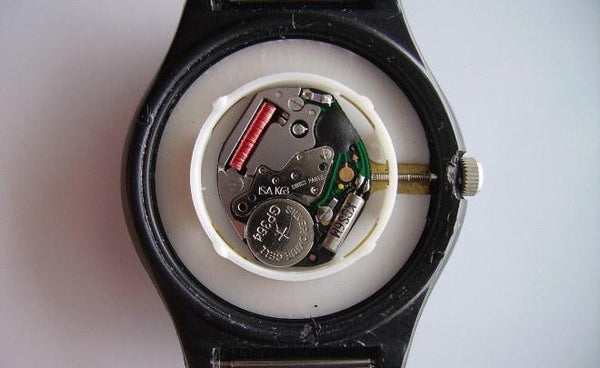
Explaining a quartz oscillator isn't rocket science either. Much like the mainspring of a mechanical movement, the battery serves as the energy store. To keep it from feeding its current to the gear train unregulated, the quartz oscillator comes into play: shaped like a tiny tuning fork, the crystal is made of synthetic material and is set vibrating by the battery's electrical voltage. The basis of this process is the piezoelectric effect, discovered in 1880 by the famous physicists Pierre and Jacques Curie. It states that certain crystals change shape when a surface voltage is applied. The crystal vibrates exactly 32,768 times per second (32,768 hertz).

Why Exactly 32,768 Hertz?
Whether TW-Steel, TAG Heuer, or Breitling: across every price range and at every manufacturer, you'll find the standard frequency of 32,768 hertz. The reason for this uniformity is not a law of physics but a standard first defined by Girard-Perregaux in 1971 and subsequently adopted by the entire industry. To understand it, we need to keep in mind what a quartz watch is ultimately aiming for: the seconds hand should move exactly once per second, in other words at a frequency of one hertz. A quartz crystal whose natural frequency, according to piezoelectric laws, is one hertz would, however, be enormous and wouldn't fit in any wristwatch. The smaller the crystal, the higher the frequency.


Watchmakers get around this with the following trick: they fit a much smaller quartz crystal (just a few millimeters) that vibrates at 32,768 hertz when electricity is applied. Naturally, the seconds hand can't tick at that speed. To reduce the frequency, a T flip-flop circuit made up of 15 individual T flip-flops sits between the oscillator and the gear train. Each of these components halves the incoming frequency. Divide 32,768 hertz by 2 fifteen times and you get exactly 1 hertz. Now the oscillations have been translated into the duration of one second and are finally passed on to a stepper motor, which transfers the energy to the gear train and thus to the hands of the Junghans, Bruno Söhnle, or any other quartz watch. Every time the oscillator (the quartz crystal) has completed 32,768 vibrations, the stepper motor delivers exactly one impulse to the gear train, resulting in one tick of the hand.


Quartz Oscillator: Many Times More Precise Than an Automatic Watch
As you can see, a quartz oscillator is easy to explain. The important question is: what advantages does this modern-seeming system, developed back in the 1920s, offer over mechanical timekeeping? The strongest argument is its massively increased precision. While a mechanical Junghans, Omega, or TAG Heuer with its balance-and-hairspring oscillator typically manages three to five hertz, the vastly higher frequency of the quartz movement delivers a massive gain in accuracy. COSC-certified mechanical watches deviate from atomic time by between -4 and +6 seconds per day, whereas average quartz calibers allow a rate deviation of just 30 seconds per month.

High-end versions such as Breitling's SuperQuartz movements improve this accuracy tenfold again. For the wearer, that means the time needs resetting every few months at most. Four further advantages of quartz technology are also strong selling points for many watch fans:
Robust, Low-Maintenance, and Thin: Further Advantages
- Durability: Compared with their mechanical counterparts, quartz oscillators are noticeably less sensitive to shocks, vibrations, and pressure. An extreme example, the Sinn UX dive watch, whose quartz movement is pressure-resistant to an incredible 5,000 meters, illustrates the point.

- Maintenance: Apart from battery changes (usually every two years), quartz watches typically require no particular upkeep, whereas mechanical movements need serious servicing (lubrication, overhaul, etc.). The more complex the caliber, the more expensive and time-consuming the process.
- Slim construction: Although mechanical movements can now be wafer-thin, quartz models on average allow for a slimmer build. A clear advantage, especially for delicate women's watches.
- Price: Even high-quality quartz movements require considerably less manufacturing effort than mechanical calibers, which is reflected in more affordable prices.


Drawbacks: Where Does the Quartz Movement Fall Short?
The share of quartz models in a brand's portfolio varies by manufacturer: while TW-Steel, Bruno Söhnle, and Maurice Lacroix offer a wide selection, electronic timekeeping is a rarity at Omega. Rolex, Patek Philippe, Audemars Piguet, and other high-end manufactures, on the other hand, have now turned away from quartz technology entirely. The reason is simple: luxury watches are emotional products. Although the quartz movement wins on rational grounds, it lacks the technical fascination of a handcrafted automatic movement built from hundreds of finely decorated parts. Complexity, mechanical know-how, and the joy of admiring dozens of delicately tuned components through a display back are, for many buyers, THE reason to own a timepiece at all in the 21st century. The quartz model lacks the aspects of a long tradition, of passing down a valuable possession that lasts "forever," and of setting oneself apart from everyday digital life. For devoted mechanical enthusiasts, quartz watches are cold utilitarian objects that don't meaningfully differ from other electronic devices.

There are practical drawbacks worth mentioning, too: first, quartz watches require more frequent visits to the watchmaker (two years of battery life versus a five-year service interval for mechanical watches); second, their longevity is considered lower. Whether this argument holds up against the sophistication of modern quartz oscillators, however, we dare to doubt.