« When Your Metal Bracelet Is Too Big »
Your new dream watch arrives, your excitement goes through the roof, and then, once the initial euphoria fades, a small disappointment: the metal bracelet doesn't fit. The good news: you don't need a watchmaker's know-how to remove or add links yourself. Read on to learn how to get the job done right, which tools you simply can't do without, and how to handle different bracelet types.
Removing Links – A Job for a Watchmaker?
If your metal bracelet is too big or too tight, you have two options: take it to a watchmaker or fix it yourself. For a jeweler, the job is a minor one, takes just a few minutes and, provided the links are intact, should cost around €20 to €30 on average. That's the best choice for anyone who doesn't own a large watch collection and rarely needs to size a metal bracelet. Enthusiasts with larger collections, on the other hand, regularly have to adjust their bracelets, which makes investing in proper tools worthwhile. Removing links without tools? Heaven forbid! If you want to protect your luxury watch from ugly scratches and other damage, steer clear of improvised household fixes and implements from your garage workshop. The watchmaker's tools you need to remove links won't cost a fortune, and they should be of decent quality for long-term reliability.

Before You Start: Proper Preparation
Before adjusting a watch bracelet, you need to identify how the links are secured: while most luxury brands today connect their high-quality links with screws, older models and entry-level watches often rely on pins. We'll explain which tools you need for each later on. First, determine whether you actually need to remove any links at all: most metal bracelets allow minor length adjustments at the clasp, for which a toothpick is all you need. The rule of thumb for a well-fitting bracelet is that you should still be able to slip a little finger between the caseback and your wrist with slight effort. If you can't achieve this with a simple clasp adjustment, links will have to be added or removed.

Before you get started, keep the following in mind:
- Prepare a flat work surface with a soft mat
- Determine how many links need to be removed or added. If there are several, remove/add them alternately on the right and left side of the clasp to keep the bracelet symmetrical.
- Spring bar tool: the way the individual links are attached to one another (screws/pins) doesn't have to match the way the bracelet is attached to the watch case. If there's no screw attachment and no quick-release bracelet system (e.g., on Zenith, Sinn watches, TAG Heuer), you'll typically need a spring bar tool.

Removing Screwed Links
Equipment: To shorten or lengthen a watch whose link bracelet is held together with screws, a single tool is enough: a watchmaker's screwdriver. A perfect fit is essential, which is why we recommend buying a set; a good-quality one with around six different sizes costs €10–20. Color-coded, the sizes typically start at 0.5 millimeters. You should also use a bracelet holder block (approx. €10) to create a stable base for the work and minimize the risk of slipping. Alternatively, both tools can be purchased as a combined device (bracelet screw remover).

Procedure: Once you've selected the right screwdriver, release a link by removing the screws on both sides. Then take out the link, bring the two adjacent links together and screw them back in on both sides. The process couldn't be simpler, but there's one thing to watch out for: many luxury brands such as Zenith, TAG Heuer or Sinn watches use a special adhesive to absorb shocks and prevent the screws from gradually working loose. There are two types of adhesive: one has to be heated to at least 60 degrees Celsius to release, while the other releases at room temperature. Typically, both allow you to adjust the bracelet yourself without any trouble. If you do feel resistance, however, we recommend taking the watch to a watchmaker.


With Pins: Removing Watch Links the Right Way
Equipment: Whether Tissot, Hamilton or Oris – many watch brands in the more affordable price range connect their bracelets with pins. To shorten a metal bracelet of this kind, you'll need one of the following options, depending on how the pins are fitted:
- Pin pusher: suitable if the pins come out with normal to light effort.
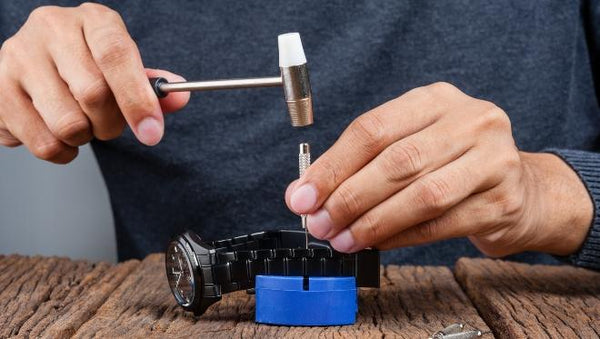
- Combination of pin punch and watchmaker's hammer: for pins that sit more tightly.
- Pin removal machine: a professional device that holds the bracelet in place and keeps the pin in a fixed position. Ideal if you're unsure about your own delicate touch.

Procedure: Many manufacturers use small arrows on the inside of the links to indicate whether, and in which direction, a link can be pushed out. Use the pin pusher to carefully push the pins a few millimeters out of the link bracelet (in the direction of the arrow). Then pull the pin out completely with fine pliers. We strongly advise against pushing the pin all the way through, to avoid it jamming or breaking. If the pin is too stiff, you'll need the combination of pin punch and watchmaker's hammer. Place the pin punch perfectly straight on the pin and drive it into the link with careful taps of the hammer (metal side) until the pin can be pulled out from the other side. Remove the link, shorten the watch and join the open ends of the bracelet. Finally, insert the pin and tap it fully into the bracelet with the soft rubber side of the hammer.

Milanese Bracelet: Can You Shorten It Yourself?
Oris, Tissot, Hamilton: many popular watch brands are increasingly using the Milanese bracelet to give their models an elegant, modern look. It's often not immediately obvious how you could shorten this bracelet yourself: the elements are extremely fine and tightly interwoven with virtually no gaps. If this metal bracelet is too big, there's often a simple way to shorten it: removing links without tools. That's possible because the individual elements are connected via a so-called slider. The slider can be opened by hand and then moved in the desired direction.


Depending on your needs, the bracelet can be lengthened or shortened, though only to a limited extent. The slider has to be positioned so that the protruding ends of the bracelet disappear underneath it. The locking cap is then closed to secure the slider in its new position. If more extensive adjustments are needed, we advise against DIY tinkering and recommend taking the watch to a watchmaker, who has the right tools to remove the links.