Watches are extremely delicate precision instruments. Making them, caring for and servicing them, and carrying out any repairs that may become necessary therefore calls for a particularly deft touch. None of this is possible without the right watchmaker tools. In this article, we introduce our readers to a selection of the most important watch tools, from case openers to movement holders, which may also be of interest to hobby watchmakers and passionate collectors.
Why should you use dedicated watchmaker tools?
As a rule, opening or repairing a watch should be left to a qualified master watchmaker. After all, the risk is simply too great that a layperson will damage the movement during an improper repair attempt or leave ugly scratches on the watch case.

Anyone who has studied the construction and function of mechanical watches in depth and truly knows their way around them may face this risk to a lesser degree. Even then, however, there is still the danger of forfeiting any warranty claims against the manufacturer if it turns out that the case in question was opened or repaired not exclusively in the manufacturer's own workshops or by a watchmaker it has authorized, but also by a third party without the manufacturer's authorization.

With older models, this consideration is certainly no longer relevant. And it is entirely understandable that someone with a passionate interest in mechanical watches will at some point want to take a look inside one of these fascinating masterpieces themselves, and perhaps also carry out repairs, replace parts, or even restore a watch that no longer works.
In all of these cases, dedicated watchmaker tools are indispensable.
Even those who only occasionally want to change the battery in their quartz watch or shorten or replace a watch strap should never get started with the first tool they find in their toolbox at home. After all, handling a watch roughly or without the proper tools risks considerable damage, ranging from scratched surfaces and deformed case edges to a broken crystal or the destruction of essential movement components.
Watch tools for opening casebacks
Opening the watch case is always the first step in any service or repair. The caseback also has to be removed for a battery change and for professional cleaning of the watch. The exact procedure and the watch tool required depend on the type of caseback and how it is fastened. On the one hand, there are so-called snap-on (press-fit) casebacks. These are pressed into the case until they stay in the desired position on their own and sit firmly. Alternatively, casebacks can be attached to the case with a threaded connection. For snap-on casebacks, a so-called case knife is used as a case opener. For this purpose, the caseback has a notch on its side.

The blade of the case knife, which is often shaped like a scalpel or a pocketknife, is placed in the notch, and with a little pressure and the right movement of the hand, the back can then be loosened until it finally pops out of the watch case. Special case opener tools are also available for opening screw-down casebacks. These engage with the corresponding recesses in the caseback at three points. The tool is then pressed firmly but gently against the watch, and its handle is turned counterclockwise so that the caseback loosens and can be unscrewed completely. High-quality case openers offer several adjustment options that allow the distance between the jaws, and thus between the bits that engage the recesses in the caseback, to be adapted to different watch sizes.
In addition, case openers come with a sufficient number of different bits, so they can be used for a variety of watch models.
The right watch tools for closing casebacks
Once the watch has been cleaned or repaired, it needs to be closed again properly. With a screw-down caseback, you simply reverse the steps used for opening. Using the case opener, the caseback is screwed back in and tightened firmly, this time clockwise. To ensure that the watch's water resistance is not compromised but fully preserved, it is advisable to carefully inspect the gasket, often called an O-ring because of its shape, before closing the case again. If any damage is visible, however minor, the O-ring should definitely be replaced. It also makes sense to apply a little silicone grease to it before closing the caseback.

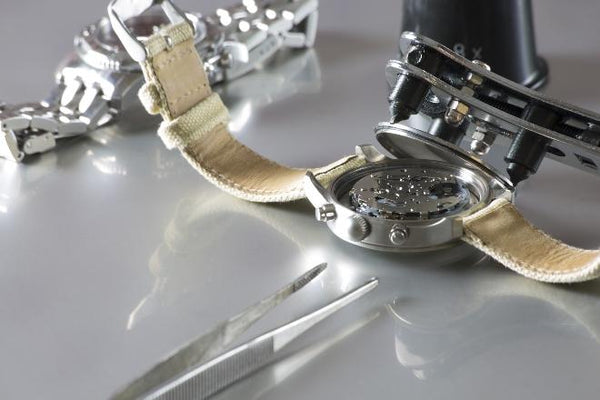
Closing snap-on casebacks is a somewhat different matter. Here, there is a risk of pinching or damaging the O-ring if the caseback is pressed in improperly. If this happens, the case loses its water resistance. Dust and other contaminants can also get inside. Pressing it in improperly with too much force against a hard surface can also damage the crystal. To prevent such damage, watchmakers use special lever presses or caseback press clamps to press the caseback in. The leverage keeps the force needed for pressing relatively low, while also making it easier to control precisely how much force is applied.

A high-quality lever press usually comes with at least six different dies and pressure plates. These allow it to be adapted to almost any common case size and help prevent scratches. Plastic pressure plates are always preferable to metal ones, as metal plates carry a much greater risk of scratching the watch case. Using the right dies ensures that the pressure plate presses the caseback into the case evenly and gently, and that the watch remains securely held at all times.
Spring bar tools, watch holders, and other watchmaker tools
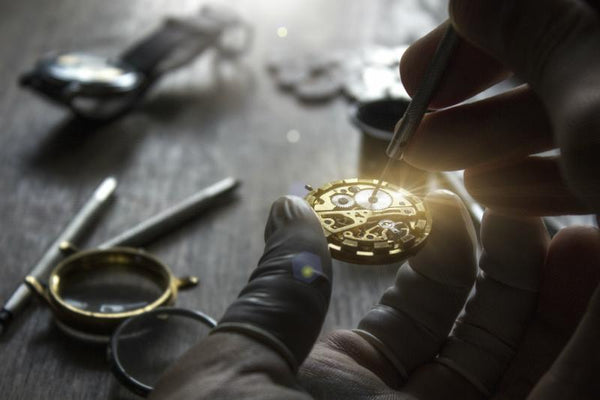
Besides the right tools and accessories for opening and closing watch cases, there are various other watch tools that are indispensable for professional watchmakers and can also serve ambitious hobby watchmakers well. First among these are watch holders, which let you gently lock a watch in the desired working position. In addition, various tweezers, polishing cloths, and very fine screwdrivers in different sizes are used regularly.

A particularly important and characteristic watchmaker tool is a loupe with suitable magnification. Even for those who have no intention of venturing inside their watch, one watch tool may be worth buying: a spring bar tool, which is used to shorten, lengthen, or replace straps and bracelets.
Quality watchmaker tools instead of cheap knockoffs
A whole range of watchmaker tool kits is now available on the market. Their scope and prices vary considerably. The offerings at the top end of the price scale are primarily of interest to professional users and are certainly unnecessary for everyone else.

However, caution is advised with watchmaker tools that are too cheap. The risk is simply too great that the strikingly low price was achieved through compromises in materials and workmanship. If that is the case, both tools and watches may be damaged, and the cost of that damage can quickly add up to far more than the supposed savings on the watch tools.
No true watch connoisseur would ever dare to work on a Rolex, Omega, or Breitling with tools like that!