“Luxury quartz watches belong in the hands of a specialist”
Outstanding accuracy, low maintenance costs and long battery life: even die-hard fans of mechanical movements can't ignore the advantages of modern quartz watches. But even the most enduring button cell will eventually run out, making a battery replacement unavoidable. Read on to find out why a specialist's expertise is crucial here and what consequences an amateur swap can have.
Precision and experience: the battery change at the watchmaker
Numerous manufacturers rely on quartz technology – whether it's the Breitling Aerospace Evo, the Tag Heuer Aquaracer or the Omega Constellation with a quartz movement.
Changing the battery sounds doable: open, insert, close – what initially seems like three simple steps actually calls for a specialist's expertise and delicate touch. If you have your watch's battery replaced by a specialist retailer, you benefit from professional handling of your timepiece, with no damage and no reduction, let alone loss, of water resistance.
This peace of mind usually comes at a low price – between €5 and €20 depending on the watch retailer – or is even provided free of charge as a service.
So how does an expert ensure a smooth battery replacement?
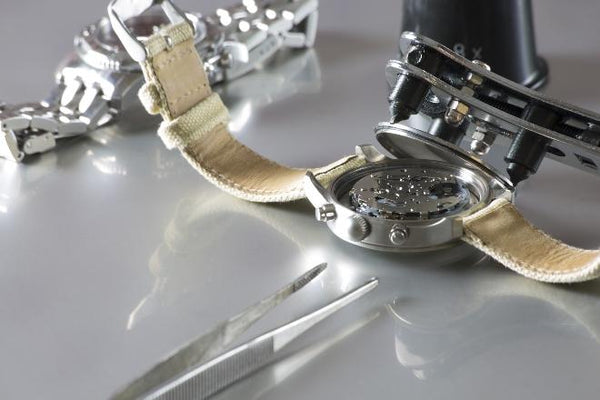
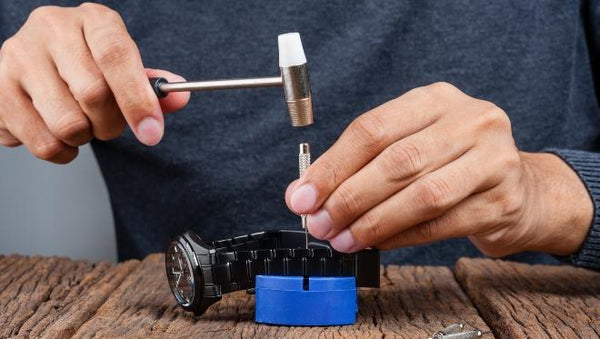
The first step is opening the caseback, which involves both a special case opener and a so-called case knife – the latter in particular is used with the utmost care so as not to damage the internal components of the luxury quartz watch. Swapping the button cell itself is less demanding mechanically, but with more than 30 different battery types, it requires expert knowledge of the watch in question and the right power cell. In addition, a specialist's approach ensures that no dust or dirt gets inside the timepiece during the change.

The final step, refitting the caseback, usually requires firm pressure. To avoid breaking the crystal on the front, watchmakers use a ring into which the watch is placed for a precise fit before the caseback is pressed in. After a subsequent water resistance test, the owner can collect the timepiece again – knowing that the watch remains in perfect condition and that its warranty is intact.
Do it yourself – how hard can it be?
From expert knowledge to the correct use of tools – it should now be clear that a battery change is anything but trivial. Of course, there is a tempting alternative to the specialist retailer: changing the battery yourself. After all, countless video and written tutorials are available online, which also offer suggestions for substitutes for professional tools.

How about a kitchen knife or a screwdriver to open the caseback, for example? That sounds so easy that we'll give it a try right away. But even with a sharp knife, the caseback refuses to budge – looks like a bit of force is needed. Unfortunately, enough force to destroy the gasket inside, which spells the end of water resistance. “Whatever,” we think, and go ahead with the battery change. Sure, the new button cell comes from the supermarket, but it's surely exactly the right one. Now just close the case with a good punch of the fist – surely great for the crystal.
From scratches to total loss: the consequences
Enough irony. The scenario described isn't fantasy, though – it reflects reality alarmingly well. Anyone who invests hundreds or perhaps even thousands of euros in luxury quartz watches can destroy much of that value with just a few wrong moves. The range of possible damage is almost limitless: scratched cases, bent battery holders, missing screws, fingerprints and dirt in the movement, short-circuited batteries and leaking cheap button cells are just a few examples of consequences ranging from minor to severe.

Given all this, it seems all the more shocking that even renowned online magazines recommend changing the battery yourself. If you weigh the high financial risk of an amateur swap against the low cost of a professional change at a watch retailer, there can be only one conclusion: the specialist retailer is the only right choice. Should you still need instructions, we at least want to provide the best possible ones:
5 steps to changing a watch battery
But first, one more reminder: with luxury watches, opening the case can affect the warranty. It is therefore recommended to have the battery changed by an authorized dealer or professional in order to preserve the watch's warranty and water resistance.
Tools you'll need
-
- A watch case opener or a pointed tool, depending on the type of caseback.
- Tweezers
- Small screwdriver
- A soft surface or a watch repair pad to prevent scratches
Remove the caseback
-
- Place the watch on the soft surface or repair pad.
- Most luxury watches have a screw-down caseback. Use the case opener to turn the caseback clockwise and open it. Be careful not to damage the case or the movement.

Remove the battery
-
- The battery is often held in place by a small metal clip. If so, use the small screwdriver to carefully loosen or remove the clip.
- Use the tweezers to take out the battery.
Insert the new battery:
-
- Make sure to use the same battery size and type as the old battery.
- Insert the new battery with the tweezers. Make sure to insert it with the correct polarity (usually with the "+" sign facing up).
- If there is a retaining clip, put it back in place and secure the battery.
Refit the caseback
-
- Place the caseback back on the watch and use the case opener to close it counterclockwise. Make sure it is tight to ensure water resistance.
The fascination of quartz – good care pays off
We've known since the seventies that automatic and luxury watches are no longer synonymous. Back then, when the first quartz watches achieved their international breakthrough, they ultimately led the Swiss watch industry – despite the initial threat – to its most successful chapter: the present. But not only the industry has been constantly evolving; so has the battery-powered wristwatch itself since its beginnings: today's high-end models offer battery life of up to ten years, enable connectivity with digital devices and impress with an almost incredible range of functions.

So it pays to take good care of these small technological marvels. Above all, this means replacing the watch battery in good time, because a dead button cell can leak over longer periods and damage the inside of the timepiece. If it's a dive watch that's actually used in the water, a regular water resistance check at a specialist retailer is recommended. An interval of one to two years should be more than sufficient.
And of course: should you notice anything unusual, such as condensation inside, a quick trip to the watch retailer is the only option.
If the watch is also adequately protected against shocks, high heat, magnetic fields and other harmful factors, nothing stands in the way of a long and trouble-free life for your quartz watch.