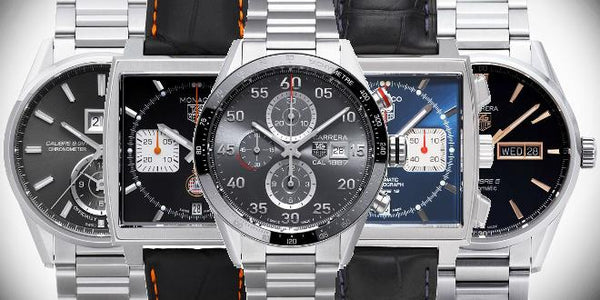
« A Monaco with an In-House Caliber »
For the 50th anniversary of its legendary Monaco, Tag Heuer launched the classic in 2019 for the first time with an automatic movement developed and produced entirely in-house. The Calibre Heuer 02 not only gives the angular Monaco technical advantages but also brings a number of visual modifications. Has the Tag Heuer Monaco thus reached the high point of its history so far? We took a closer look at the hotly debated anniversary model.
The Long Road to an In-House Movement
When the first Tag Heuer Monaco was unveiled to the world in 1969, its Calibre 11 made it one of the very first automatic chronograph movements ever. Presented just a few weeks after the famous Zenith El Primero, it was the product of a collaboration between Heuer, Breitling, Hamilton-Büren, and the specialist module maker Dubois Dépraz.
The movement became famous above all for its left-hand crown, the complexity of its development, and its excellent technical reliability.
The Calibre 11, however, never earned the title of "in-house movement." It was fitted to a Monaco for the last time in 1979, after which the square chronograph fell victim to the quartz crisis and was discontinued for several years. Following a few re-editions and attempts at revival, the Monaco only became a permanent part of the Tag Heuer collection again in 1998, drawing its power from the solid but unspectacular ETA 2894-2 with a right-hand crown.
The current version of the Monaco automatic chronograph saw the light of day in 2015, but once again arrived without an in-house movement, letting buyers choose between two engines: while the (modern) Calibre 11 is based on the Sellita SW-300 and features the traditional left-hand crown, the ETA 2894 carries on under the name Calibre 12.
Calibre 02: More Power Reserve and a Better-Looking Caseback
Then, in 2019, came the big bombshell: right on time for its 50th anniversary, the Monaco appeared with an in-house movement. It uses the Calibre 02, first introduced in 2017 in the Autavia, with a vertical clutch, column-wheel control, and a frequency of 28,800 vibrations per hour.

Not only in terms of prestige and marketing but also technically, the in-house movement takes the chronograph to a new level: while the power reserve climbs from the previous 42 hours of the ETA designs to a hefty 80 hours, the visual appeal of the caseback improves enormously.
The Calibre 11 and 12 of earlier Monacos can also be admired through a sapphire crystal caseback, but they look somewhat drab and too small for the imposing 39 x 39 millimeter case. The Tag Heuer in-house movement is far more exciting: its modern design with a red column wheel and skeletonized rotor, along with its larger 31-millimeter diameter, make a look inside a noticeably more thrilling experience.
New Dial with a 12-Hour Counter
Numerous internal modifications were needed to fit the in-house Calibre 02 into the angular case of Ref. CBL2111.FC6453. Identical in size and shape to the previous Calibre 12, the stainless steel case stands out for its right-hand crown and comes on a blue alligator leather strap matching the dial, complete with a folding clasp. Speaking of the dial: on the front, the Tag Heuer Monaco presents several changes compared with the earlier editions without an in-house movement.

The most obvious evolution concerns the two totalizers: the 30-minute counter moves from 9 o'clock to 3 o'clock, while the former small seconds at 9 o'clock is replaced by a 12-hour counter. Another novelty on the in-house Monaco is the beveled edges of the subdials, which give the dial greater three-dimensionality. And what happened to the small seconds?

It has moved to the lower center of the Heuer, where it shares space with the date display, crossing its window for a few seconds every minute. Certainly not the most elegant solution, but few fans are likely to find it truly bothersome. The same goes for the "Automatic" lettering, shifted slightly upward, which once again illustrates how limited space is even on large dials.
True to Steve McQueen's Original
Despite these changes, the new Monaco has remained its old self at heart. The sunburst finish of the metallic blue dial shines just as splendidly as it did on Steve McQueen's wrist in "Le Mans," while the silver totalizers provide the familiar strong contrast.

Naturally, the red hands for the seconds and subdials are also essential to completing the picture of the legendary racing driver's watch. This keeps the new edition with the Tag Heuer in-house movement very close to the original model, whose 1971 film appearance contributed significantly to the fame of every Monaco that followed. For lovers of the angular classic, that is a decisive factor, since the rich history of the angular chronograph plays a major part in its fascination.

Has this history now reached its high point to date with the in-house Caliber 02? We are convinced it has. Without losing its aesthetic character, the new model with its high-performance movement achieves a dramatic improvement in its technical capabilities. At last, case and movement come from the same house – a complete package that many Monaco fans have long wished for. Now the dream becomes reality.

And best of all: with a list price of €5,800, the edition with the in-house movement costs exactly the same as the Calibre 11 version (Ref. CAW211P.FC6356) and is not worlds apart from the Calibre 12 version (Ref. CAW2111.FC6356), which carries a price tag of €5,050. For us, a clear choice.