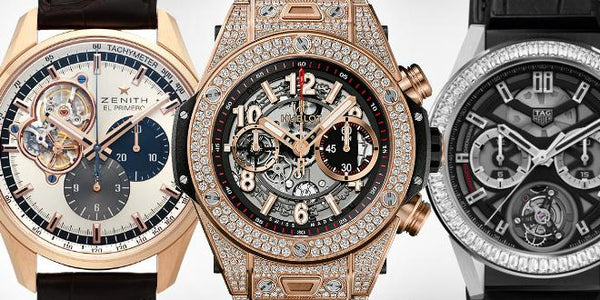
TAG Heuer is without doubt one of the best-known names in luxury watchmaking today. The brand is especially closely tied to motorsport – thanks above all to its expertise in developing and building high-performance sports chronographs. Throughout the most diverse eras of watchmaking history, the manufacture has repeatedly achieved groundbreaking technical innovations that made timekeeping in sport easier and more precise – from early stopwatch models and quartz chronographs with analog displays to the first wrist chronograph accurate to one hundredth of a second. Today, watch enthusiasts particularly appreciate the famous Carrera and Aquaracer collections, as well as the wide range of sporty women's watches. We've put together a few interesting facts about TAG Heuer for you here:
1. What does TAG actually stand for?
Contrary to what you might assume at first glance, TAG is not the initials of the owner or the company's founder – his name was Edouard Heuer. In 1860, at the age of 20, the young man founded a watchmaking workshop in St. Imier that grew so quickly that he was able to open a branch in London as early as 1876.
With the patent for its "oscillating pinion" for mechanical chronographs in 1887, the company reached its first milestone in a history shaped by countless technical innovations.
For more than a century, the watches made by him and his successors bore only the name "Heuer" on the dial. The TAG prefix was added only after the merger with the TAG Group in 1985 and stands for "Techniques d'Avant Garde."
2. Who owns the company today?
After the company went public in 1996, the French group Moët Hennessy Louis Vuitton S. A. (LVMH) acquired the storied watchmaker in 1999. LVMH is one of the world's leading luxury goods companies and brings together numerous renowned luxury brands under one roof.
Incidentally, TAG Heuer is headquartered today in La Chaux-de-Fonds.

3. The first stopwatch to measure hundredths of a second
Another important step on the way to becoming one of the most renowned sports watch manufacturers was the Mikrograph. Introduced in 1916, this stopwatch was the first in the world to measure time accurately to one hundredth of a second.
It was soon followed by the Mikrosplit, a chronograph with split-seconds (rattrapante) hands that could even measure two different times running simultaneously.
4. Three-time Olympic timekeeper in the "Roaring Twenties"
By the 1920s at the latest, Heuer had established itself internationally as a renowned sports watch brand. This was due in large part to the fact that the company served as official timekeeper for the first time at the 1920 Olympic Games in Antwerp, and again at the following Games in Paris in 1924 and Amsterdam in 1928.
5. Dashboard timers for race cars – the entry into motorsport
The brand's involvement in motorsport intensified above all from 1933, when the company began developing and producing its first dashboard timers for race cars. A well-known model from this period is the Autavia stopwatch, introduced that same year, whose name combines the words automobile and aviation. It was designed both as an instrument for aircraft cockpits and for installation in cars.
6. Where does the Carrera collection get its name?
Carrera is the name of one of the brand's most successful collections, which is still in production today and is continually expanded with new models. It has held its own on the market for more than half a century, making it one of the most successful watch collections in the history of watchmaking.
It takes its name from the "Carrera Panamericana Mexicana." Inspired by this rally, Heuer introduced the first chronograph of the line in 1964, distinguished above all by its functional dial.
7. From the first water-resistant automatic chronograph with a square case to the first belt-driven watch
On March 3, 1969, Heuer unveiled the famous Calibre 11 to the public for the first time. This automatic chronograph movement was jointly developed by Breitling, Dubois Dépraz, Hamilton/Büren and Leonidas. Although it reached the market two months after the "El Primero" automatic chronograph from Zenith/Movado, and after an even earlier model developed by Seiko in Japan, it still made history in the form of the Monaco as the world's first water-resistant automatic chronograph with a square case. Steve McQueen and his racing film "Le Mans" contributed significantly to this. With it, Jack W. Heuer, the founder's great-grandson, achieved one of the first-ever product placements of a watch in a movie.
The Monaco collection has also been continually refined. In 2004, with the Monaco V4, the traditional Swiss brand introduced the world's first watch featuring a belt drive, a linear oscillating weight and ball bearings. In 2014, the first belt-driven tourbillon was presented in a Monaco V4 at Baselworld.
8. The first stopwatch to measure thousandths of a second
In 2011, TAG Heuer reinforced its reputation as one of the leading makers of high-end sports watches with the Mikrotimer Flying 1000 Concept Chronograph. This concept watch can measure elapsed times accurate to one thousandth of a second. This is made possible by a balance beating at 3,600,000 vibrations per hour. As with the Mikrograph 1/100th, the system is based on two independent gear trains.
9. A tourbillon chronograph for less than €15,000
One of the most recent milestones in TAG Heuer's history is the world's most affordable tourbillon chronograph, announced in 2015 and presented at Baselworld 2016 as the Carrera Calibre Heuer 2 Tourbillon COSC. As promised, its price of €14,950 came in below the €15,000 threshold. It is powered by the chronometer-certified automatic Heuer-02T movement.
The list of interesting facts and groundbreaking innovations could surely be extended with many more examples – such as the first chronograph with a worldwide tide indicator and a special regatta dial, the first quartz chronograph with an analog display, or the first mechanical movement without a hairspring.


All of these examples – whether concept watches or successful, production-ready collections – show that the company once founded by Edouard Heuer has lost none of its drive and innovative strength, and year after year continues to delight with new men's chronographs and sporty women's watches, as well as elegant dress watches.