Around the world, Geneva, La Chaux-de-Fonds, and Le Locle are names that ring sweetly in the ears of watch enthusiasts. After all, some of the most renowned luxury watchmakers are based there. The same goes for the small Saxon watchmaking town of Glashütte. But who still remembers the importance that places like Pforzheim and Schwenningen once had for the watch industry? In this article, we take a look at Germany's forgotten watch towns.
The Origins of the German Watch Industry in the Black Forest
Mention luxury watches, and most watch enthusiasts today think almost automatically of Switzerland. And indeed, the Alpine republic is today one of the world's leading watch manufacturers and exporters. Measured by the total value of watches produced and exported, it likely still ranks first; if you go purely by the number of units manufactured and sold, however, manufacturers from the Far East are more likely to occupy the top spots. Only a few watch connoisseurs who have delved a little deeper into history are still aware of the leading position German watchmakers once held in international watch markets. Back then, several German cities were known worldwide as centers of the watch industry.

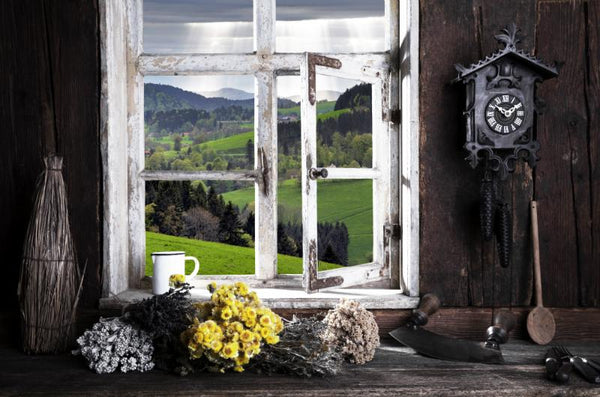
Particularly noteworthy in this context is the Black Forest, where clocks were manufactured in large numbers and exported to many countries even in pre-industrial times. Exactly when clockmaking began in the Black Forest can no longer be precisely determined. It is considered certain, however, that the first Black Forest clocks – still made of wood at the time – were produced as early as the second half of the 17th century. Due to armed conflicts in the region, though, it took until around 1730 for clockmaking to establish itself there as a trade of any significant scale.

From the second half of the 18th century until well into the second half of the 20th century, however, the watch and clock industry played an important role far beyond the borders of the Black Forest. Although pocket watches and wristwatches were later produced alongside the initially dominant longcase and wall clocks, large clocks and alarm clocks always played the bigger role there overall.
Industrialization and Global Expansion
Even the wooden Black Forest clocks of the 18th and 19th centuries sold so well, both at home and in foreign markets, that Black Forest products soon achieved a dominant market position. Incidentally, the choice of wood as a material for clockmaking was not primarily for technical reasons, nor was it mainly due to the ready availability of this material in heavily forested regions.
These two factors certainly favored the development, but the decisive role was most likely played by the guild regulations of the time.
While guild rules reserved the manufacture of metal clocks exclusively for urban clockmakers, no such restrictions applied to wooden clockmaking. The fact that Black Forest wooden clocks were able to establish themselves faster and more successfully in international markets than comparable products from other regions was due to another distinctive feature of Black Forest clockmakers. Earlier than elsewhere, they relied on a consistent division of labor. A clock was no longer made entirely by a single clockmaker but was assembled from parts supplied by various specialized suppliers.
In the process, distinct trades emerged – such as frame makers, chain makers, dial turners, dial painters, and many more. The division of labor and the development of new manufacturing methods allowed for a significant increase in productivity. Nevertheless, until well past the middle of the 19th century, production still took place in numerous small workshops that were integrated into residential homes and whose owners almost always employed several journeymen and apprentices as well.
Around 1840, some 1,000 workshops in the Black Forest produced a total of about 600,000 wooden clocks a year, which at the time accounted for a large share of global production. From 1880 onward, a relatively rapid transition to industrial clock manufacturing followed, after it had already become increasingly clear that the many tiny businesses would not be able to survive in this form and more and more larger workshops had emerged.
Clock Factories and Watch Towns Emerge in the Black Forest
The first clock factories in the true sense initially arose in the part of the Black Forest belonging to Baden and were concentrated in easily accessible locations that, where possible, also offered the opportunity to use water power. Such watch towns included, in particular, Furtwangen, Lenzkirch, St. Georgen, Titisee-Neustadt, and Triberg.
After 1880, the Black Forest watch industry increasingly shifted to its Württemberg part and to the Baar, a high plateau linking the Black Forest and the Swabian Jura.
Schramberg and Schwenningen in particular, but also Pforzheim, gained worldwide fame as centers of the watch industry. In Schramberg, this was owed above all to the successful expansion of Junghans and of the Hamburg-Amerikanische Uhrenfabrik, which was also based there.
Major watch and clock manufacturers in Schwenningen, on the other hand, were Kienzle and Mauthe, as well as the Württembergische Uhrenfabrik Bürk and ISGUS, which mainly produced time recorders. In parallel with the emergence and growth of industrial enterprises, small businesses steadily lost importance. Industrial mass production modeled on American examples now set the tone. The various individual components were optimized for the most time-efficient assembly possible.
The W10 alarm clock movement, developed by Junghans in Schramberg in the early 1880s, would prove to be a particular milestone.
Its success contributed significantly to the Schramberg company's rise to become the world's largest watch and clock manufacturer around 1900. Alarm clocks fitted with this movement, or with copies of it made by other Black Forest manufacturers, became the most affordable and sought-after models on the world market – just as the Black Forest wooden clocks had been a few decades earlier.
Transformation and Decline – Watch Towns in the Wars and the Quartz Crisis
World War I brought German watch and clock production almost to a complete standstill and thus hit the watch towns hard. By producing time fuzes and other armaments, manufacturers such as Junghans in Schramberg and Kienzle in Schwenningen were able to open up alternative lines of business, but the economic crisis and the political changes of the postwar period placed a considerable burden on the industry and the regional watch towns, and into the early 1930s numerous Black Forest manufacturers were forced to file for bankruptcy and close their businesses.

In the years after World War II, the region's watch industry was unable to recapture its former success. While cheap mass-produced goods from Asia increasingly flooded the market, demand in the luxury segment became ever more concentrated on renowned manufacturers based in Geneva, Le Locle, or La Chaux-de-Fonds. In the mid-1970s – in the course of the so-called quartz crisis – a second wave of bankruptcies followed, which especially affected suppliers.
That is how a number of German watch towns fell into oblivion, and why names like Schwenningen or Pforzheim hardly evoke any such associations today, even among watch connoisseurs.

German Watch Towns Today
Today, Pforzheim is known primarily as a center of the jewelry industry, while watch production plays a rather minor role there. As the home of Junghans, Schramberg is still familiar to many watch fans – not least because of this manufacturer's pioneering role in developing products such as solar and radio-controlled watches. German watch towns located outside the Black Forest have often undergone a similar development.

In Ruhla, Thuringia, the first machine-made pocket watch, the "Ruhlaer Kartoffel" (Ruhla potato), had been produced since 1890. Watches are still made in Ruhla today, but for lack of well-known brands with a presence in the luxury segment, the town is hardly perceived as a watch town beyond its region anymore.
A refreshing exception is Glashütte in Saxony, where a highly capable watch industry had likewise developed back in the 19th century – one that never entirely lost its significance and was able to build on its former success after German reunification.

Today, Glashütte is probably the only German location where several internationally renowned luxury watchmakers produce side by side – brands that can certainly hold their own against their competitors from Geneva, Le Locle, and La Chaux-de-Fonds in international markets.
Here, enthusiasts can marvel at watches from Bruno Söhnle, Mühle, Union, Nomos, and Glashütte Original!