« From the Milgauss to the De Ville Trésor »
They are invisible, can cause massive deviations in rate, and today they are almost everywhere: magnetic fields. To fend off their effects, many mechanical watches rely on antimagnetic materials and Faraday cages. We explain how this shielding can work and present some of the most stylish antimagnetic watches.
New Solutions to Old Problems
Since the dawn of mechanical horology, watchmakers have known about the fatal consequences of magnetic fields. Once brought near delicate components such as the wafer-thin balance spring, they can cause anything from slight inaccuracies to rendering the affected movement completely useless. While comparatively few sources could cause such magnetization in the 19th century, today's digital life is full of potential interference: not only induction cooktops and fridge magnets, but also smartphones, speakers, and computers pose a threat to the precision of mechanical watches. Smart answers from the watch industry are therefore more in demand than ever.

There are two approaches to choose from: while early models from the 1950s got their magnetic protection from a soft-iron shell around the movement, which provided shielding based on the principle of a Faraday cage, today's editions mostly rely on antimagnetic movement components – made of silicon, for example. As a result, sensitive parts such as balance springs, pallet forks, or balance staffs cannot become magnetized in the first place, and since the soft-iron shell is no longer needed, they can be admired through a display caseback. The effectiveness of the protection also increases considerably with this method.
Omega De Ville Trésor with the Antimagnetic Master Co-Axial Caliber 8511
Just how effective modern antimagnetic watches can be is demonstrated by the Omega De Ville Trésor with its antimagnetic Master Co-Axial Caliber 8511. Featuring a free-sprung silicon balance spring and two barrels mounted in series, this movement delivers a 60-hour power reserve and shows off its exclusive red-gold balance bridge behind a sapphire caseback. Even more impressive, however, is that it achieves magnetic resistance up to 15,000 gauss without any Faraday cage at all. For comparison: neodymium magnets are among the strongest of their kind and generate "only" 2,000 gauss at their surface. The hand-wound movement is housed in a 40 mm white or yellow gold case which, together with the timeless "Clous de Paris" pattern on the dial, makes for a gorgeous dress watch. Our favorite is the white gold reference 432.53.40.21.02.004, which according to the manufacturer costs €12,960.

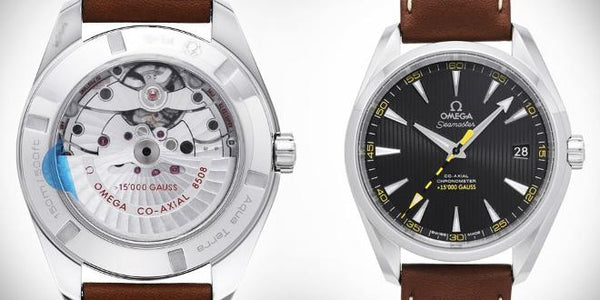
Just as effective but considerably more affordable, by the way, is the steel Seamaster Aqua Terra Chronograph "> 15,000 Gauss" (Ref. 231.10.42.21.01.002 on a steel bracelet). Apart from its automatic winding, its Caliber 8500 is nearly identical to the 8511 and can likewise be admired through a display caseback. Measuring 41.5 mm, the elegant diver catches the eye with its yellow accents and, according to the manufacturer, comes in at €5,360.

An Antimagnetic Classic: Rolex Milgauss
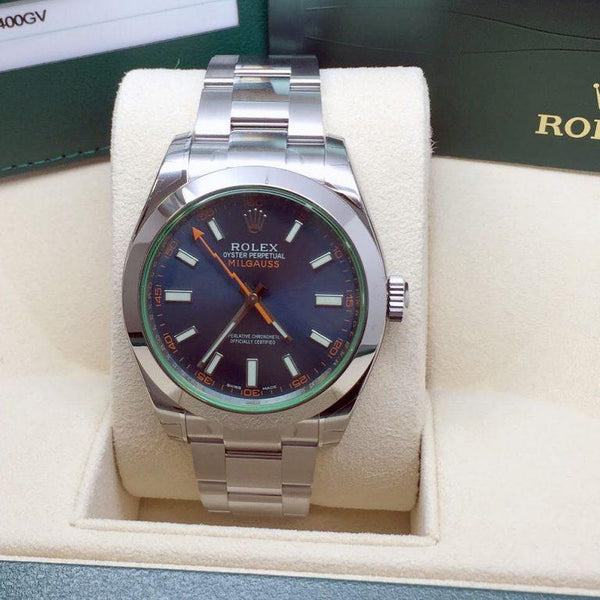
Unlike the Seamaster, the Rolex Milgauss takes the technically more traditional approach: created in 1958 in collaboration with CERN, it still features a Faraday cage today and has undergone numerous improvements over its more than 60-year history. In modern editions, the protection of the soft-iron shell is complemented by well-known Rolex innovations such as the Parachrom hairspring, which is why the watch should be able to withstand considerably more than the 1,000 gauss that gave it its name. As one of the best-known antimagnetic watches, the 40 mm Milgauss is loved not only for its robustness but also for its lightning-bolt seconds hand and its green sapphire crystal (which is not used on any other model) – standout details in a product lineup often criticized as monotonous. If we had the choice, we would go for Ref. 116400GV with a light blue dial and pay a manufacturer's price of €7,600.
Pure Functionality: Sinn Spezialuhren 856 S
At a considerably lower price, but with technical foundations similar to those of the Rolex Milgauss, Sinn's 856 S pilot's watch sets out to win over customers. Its magnetic protection is likewise based on a soft-iron cage, formed by a combination of the dial, movement holder ring, and caseback. Much like its Geneva rival, this results in shielding up to 1,000 gauss, or 80,000 amperes per meter. Unsurprisingly, the technical package of the Sinn Spezialuhren 856 S is rounded out by further innovations: the black hard coating on a tegimented base ensures high scratch resistance for the 40 mm case, while Ar-Dehumidifying Technology prevents the oils from aging and thus guarantees greater functional reliability of the automatic Sellita SW300-1. Particularly striking is the excellent legibility of the dial, which, together with 200 meters of water resistance, gives the pilot's model outstanding functionality. On a black stainless steel bracelet, the watch costs €2,140.

High-Tech Antimagnetic Watches: Zenith Defy El Primero 21
The Zenith Defy El Primero 21 proves that antimagnetic properties are compatible with complications, too. Since its launch in 2017, it has enabled mechanical timing accurate to a hundredth of a second, achieved by means of a two-part movement: a conventional 5 Hz escapement is responsible for the timekeeping, while a separate 50 Hz escapement is engaged only when the chronograph function is activated.
Its enormous energy consumption limits timing to around 50 minutes, but the revolutionary mechanics of the El Primero 9004 caliber are permanently visible through the skeletonized dial. There, the 44 mm powerhouse reveals the reasons for its high magnetic resistance: the balance springs of both escapements are made from a special carbon nanotube matrix and, together with other antimagnetic components, are said to protect against more than 15,000 gauss. Numerous variants of these impressive antimagnetic watches are available, in titanium, ceramic, carbon, or gold. If you want to own the classic titanium version (Ref. 95.9000.9004/78.M9000 on a metal bracelet), you will have to send €12,800 to Le Locle.