« How Everyday Magnetism Makes Our Watches Less Accurate »
Whether in electrical engineering, medicine or industry, magnetic fields perform important and even life-saving tasks. For watch lovers, however, they are a thorn in the side, because they can noticeably reduce the accuracy of mechanical timepieces. We explain the sources of magnetism in everyday life, how to demagnetize an affected watch, and what measures manufacturers use to make their models more resistant to magnetic fields.
Sources of Magnetism in Everyday Life
Electronic devices shape almost every aspect of our daily lives: from induction cooktops to smartphones to Bluetooth headphones, countless magnetic fields surround us, and they can have a damaging effect on the accuracy of mechanical watches. Some degree of exposure is therefore unavoidable. The question is which sources are the worst culprits and whether they can be deliberately kept away from your timepiece. The answer is yes: if you keep soundbars, PCs and tablets away from your watch, you avoid the most severe effects. Seemingly harmless objects such as blenders or handbags with magnetic clasps are also among the biggest causes of disrupted timekeeping.

What Happens When a Mechanical Movement Becomes Magnetized?
When it comes to magnetism, the distinction between quartz and mechanical watches is crucial. While the former are largely resistant and only run inaccurately while they are inside a magnetic field, the effect on manual-wind and automatic models is lasting. Their operation relies on dozens, often even hundreds, of moving metal parts that must work together in perfect harmony for precise timekeeping. When a magnet comes into play, this symphony is thrown off balance. Depending on the strength of the source and the duration of exposure, various consequences are possible – from a few seconds of daily deviation to the movement stopping completely. The main problem is the delicate balance spring, whose coils are drawn closer "together" by magnetic fields, generating unnecessarily high force and speeding up the oscillation. As a result, the watch runs fast.

How to Tell If Your Watch Is Magnetized
If this change in rate is pronounced enough, it is already a strong indication of magnetization. However, mechanical faults or a needed service could also be the cause. Before having a watch demagnetized, an additional test is therefore advisable: place a compass next to your timepiece, and if the needle deflects, you can identify a magnetized watch. Fortunately, this is the most harmless kind of "damage" a timepiece can suffer – having your wristwatch demagnetized solves the problem within a few seconds, and you can expect no long-term effects on the watch.

Fixing the Problem: Demagnetizing a Wristwatch
If you want to demagnetize a watch, you have two options: take it to a professional watchmaker or do it yourself. Relying on an expert gives you the certainty that the job is done properly, along with a quick, inexpensive procedure. Demagnetizing a wristwatch in a shop takes a few minutes and should exceed €20 only in exceptional cases – many retailers even offer the service free of charge to their own customers. Collectors and enthusiasts who rarely deal with the effects of magnetization make the right choice by having an expert fix the issue, and they can have the rest of the watch's functions checked at the same time. If you cannot avoid magnetic sources in your private or professional environment, you will encounter the problem more often and should consider demagnetizing your watch yourself.

How Do You Use a Watch Demagnetizer?
The solution is a watch demagnetizer, a simple device that requires no expertise to operate. The range in quality is wide: while professional devices for watchmakers cost hundreds of euros, inexpensive units are available online for as little as €10. These are mostly Chinese imports that lack EU-wide safety standards such as the CE mark – use at your own risk. In our experience, however, they do their job without a hitch and can demagnetize a wristwatch so that its rate is no longer disturbed afterward.
How to use it: to demagnetize the watch, place it with the caseback on the device's contact surface, switch the device on and leave the timepiece on it for a few seconds. While the demagnetizer is still switched on, slowly move the watch away from the contact surface, and repeat the process if the problem has not been resolved. How do you know whether the magnetization has been removed? If the deviations were extreme beforehand and amounted to several minutes per day, it is enough to wait a day and compare the time. If you want to measure finer effects, you need a timegrapher – the same measuring device watchmakers use.

Prevention: Buying Antimagnetic Watches
As we can see, demagnetizing a wristwatch is no rocket science. Nevertheless, renowned manufacturers such as Rolex, Omega and Sinn go to great lengths to make their models more resistant to magnetic fields. Wearers who cannot avoid regular exposure to magnetic fields benefit in particular from these technologies and are spared the recurring effort of demagnetizing their watch.


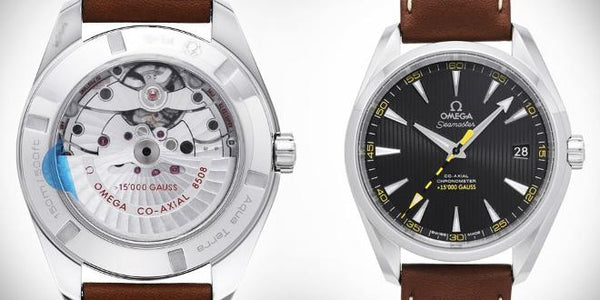
The approaches differ: while soft-iron cages, as in the Rolex Milgauss, shield the movement from the outside world, modern components such as silicon balance springs solve the problem "from within" and achieve the highest possible resistance. Omega's Co-Axial calibers, used in the De Ville Prestige among others, promise resistance to up to 15,000 gauss, which equals around 1.2 million amperes per meter and thus the magnetic field of a typical induction cooktop.

 [box type="info" align="" class="" width=""]Important: These watches can also become magnetized, but they withstand magnetic fields far better than unprotected timepieces. In any case, having your wristwatch demagnetized is often an effortless way to resolve poor timekeeping accuracy.[/box]