« What is an in-house movement? »
For many watch enthusiasts, the fascination of mechanical movements is the most important part of the hobby. But not all calibers are created equal: in-house movements generally enjoy a higher reputation than mass-produced ones and, in the upper price ranges, are practically expected of any serious manufacturer. But what exactly is an in-house caliber, and where do you draw the line between it and an off-the-shelf movement? We explain the topic and why self-built movements have become increasingly popular in recent years.
All under one roof: the in-house movement
An in-house movement (or manufacture movement) is a mechanical caliber that comes from a watchmaker's own production. This sets it apart from mass-produced movements, which are made by suppliers such as ETA or Sellita, sold to the brands, and then fitted into the manufacturer's cases ("cased up"). Known in English as an "in-house caliber," a manufacture movement involves considerable additional cost for the watch brand because of its elaborate development and production, which is why you find them far more often in the luxury segment than in entry-level models.


High-end manufactures such as Breguet or Blancpain, for instance, rely exclusively on movements they produce themselves, while mid-range watches from brands like Union Glashütte or Longines use modified mass-produced movements.
Modification is the key word here, because the line between an off-the-shelf and an in-house caliber can be very blurry. Take Union Glashütte: although the base of its Saxon movements is supplied by the Swiss industry leader ETA, the finishing and quality control are carried out in-house, as is the production of the rotor. These are clear characteristics of an in-house movement, requiring visibly greater manufacturing expertise than a standard mass-produced caliber.
This example highlights a complex issue that regularly sparks debate among experts: at what point can a movement legitimately be called in-house?
Why are self-built movements so sought after?
The question becomes even more complex once you factor in where the individual components come from. In the strictest sense, an in-house caliber would not only have to be assembled in-house but also consist exclusively of parts the brand makes itself. That ideal is almost never achieved in reality – around 90 percent of Swiss hairsprings, for example, come from the workshops of the specialist company Nivarox FAR and are used even in the most expensive in-house movements. So even the most devoted fans of self-built movements have to accept a certain amount of outside involvement.
Where does the strong appeal of the in-house movement actually come from?
Most enthusiasts are fascinated by the idea of completeness: owning a watch that embodies the manufacturer's character not just on the outside but on the inside as well is a special feeling. Granted, a mass-produced movement can also convey the charm and complexity of traditional mechanics. But only with an in-house movement do these qualities meet a sense of uniqueness and personality. Like a Ferrari and its engine, case and movement form an inseparable whole.
Add to this a level of technological effort that is second to none: Omega, for example, invested the equivalent of more than €90 million in developing its Co-Axial chronograph caliber 9300 – a hefty sum even for a giant of the watch market. As a result, buyers get the (accurate) impression that their movement was designed "for them" rather than for the mass market.
In-house calibers: the stars of the watch world
This idea of individuality becomes even clearer when you look at some famous in-house movements. Take the Zenith El Primero: introduced in 1969 as the world's first automatic chronograph movement, it is renowned for its high frequency of 36,000 vibrations per hour (5 Hz) and is still regarded as a technological masterpiece 50 years after its debut.
Or the Glashütte Original 61-03: it beats at only 4 Hz, but in return it treats the viewer to spectacular decoration, including the prominent swan-neck regulator from the Saxon watchmaking town. In-house movements diversify the watch world, give it variety, and make it exciting. It's like exclusive cars: it is precisely the variety of elegant Bentleys, fast Lamborghinis, and many other marques that generates excitement and passion.
Setting emotional aspects aside, an objective question arises: is an in-house movement always better than a mass-produced one? The clear answer is no. Often it's actually the other way around, when the time-tested, reliable technology of mass-produced calibers is pitted against the new and unproven technology of in-house developments.


If an expensive in-house movement then develops faults, buying the watch turns into a disastrous experience. Servicing is also more difficult: while widely used off-the-shelf calibers are everyday business for most watchmakers, in-house movements require specialized training.
The trend toward in-house movements
Given these facts, you might wonder why the development of new in-house calibers keeps growing in the watch industry and has reached new heights in recent years. Wouldn't it be much smarter to buy reliable mass-produced movements and refine them to suit the brand? The reason for the current trend has less to do with passion than with pragmatism: since the early 2000s, ETA – by far the largest movement supplier – has been pursuing a significant reduction in its output. For several years now, it has no longer supplied individual components to the brands, only complete calibers. This shrinking supply practically forces manufacturers to produce their own movements – a development that watch fans are likely to welcome.

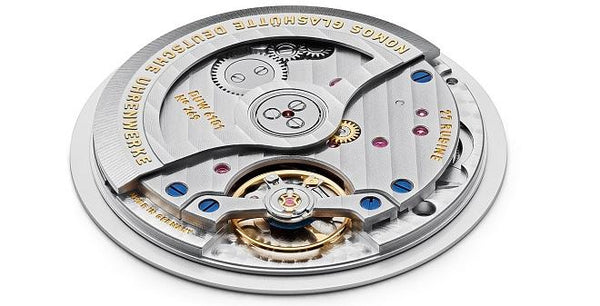
Incidentally, this shift toward independence isn't limited to the luxury segment; it can also be seen in the more affordable price range. Alongside successful Swiss models such as the Tudor Heritage Black Bay Steel with caliber MT5612, NOMOS Glashütte is an excellent example: today, every timepiece from the German manufacturer is equipped with an in-house movement, and its vertical integration stands at a near-record 95 percent.
The art of in-house mechanical production has long been established in Japan as well, as Seiko demonstrates. The heritage brand makes all of its calibers in-house, making it the ultimate example of affordable in-house movements. A genuine recommendation for anyone who wants to dive into the world of mechanical horology with an in-house movement.