« New Classic or Passing Trend? »
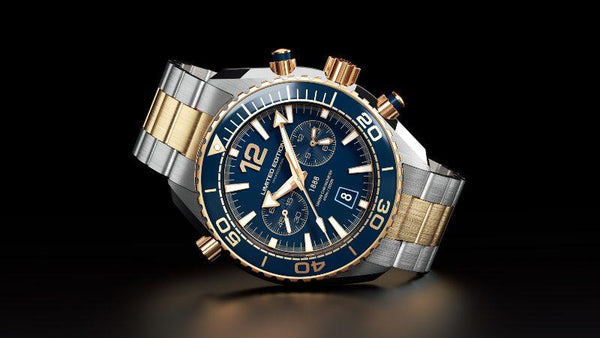
Omega Seamaster, Rolex Submariner, Breitling Superocean: Many of the most famous luxury watches of our time would be unthinkable without their ceramic bezels, from both a functional and an aesthetic standpoint. Once reserved for the high end, this hard material is growing ever more popular and is increasingly making its way into more affordable price ranges. We discuss whether watches with ceramic bezels are becoming the long-term standard or simply mark a current trend, and we present five exciting models featuring this advanced detail.
Ceramic Bezel or Ceramic Insert? The Subtle Difference
When people talk about watches with ceramic bezels, in most cases they don't mean the ring itself, which is typically made of the case material (e.g., stainless steel), but rather the bezel insert. The insert is set into the bezel and is usually made of aluminum, titanium carbide, or ceramic – in some cases with an additional sapphire crystal layer, as on the Blancpain Fifty Fathoms, for example. Nevertheless, the term "ceramic bezel" is widely used for any bezel with a ceramic insert.

Not a Trend, but Technical Progress
We see watches with ceramic bezels as a long-term technical improvement rather than a short-lived trend. The reason becomes clear when you compare them with the (anodized) aluminum bezel, the most common alternative to the ceramic insert: while aluminum reaches a low hardness of around 300 HV on the Vickers scale, which shows up as visible scratches, especially on dark bezels, ceramic inserts boast an average of 1,250 HV. With proper care, the result is eternal, scratch-free youth. Add to that high corrosion resistance and heat resistance. Aesthetically, we also prefer the ceramic bezel, because we find its glossy look more upscale than matte aluminum.

The only significant argument against watches with ceramic bezels is cost. Not only is producing the inserts more demanding for watch brands than aluminum, so is finishing them. Two-tone or multicolor ceramic bezels are particularly challenging, because the color transitions have to be precise. Engraving exact scales into the ceramic adds further effort, which luxury manufacturers such as Omega tackle with laser engraving. The good news: as existing production processes are optimized, ceramic bezels are becoming cheaper and can increasingly move into other price brackets. The lower the hurdles to manufacturing these modern inserts become in the future, the more widespread the ceramic bezel will be in the watch world.

Tissot T-Sport Seastar 2000 Powermatic 80
A prime example of an affordable model with a ceramic insert is the massive 46 mm Tissot T-Sport Seastar 2000 Powermatic 80 (Ref. T120.607.11.041.00). For €1,030, the buyer gets not just plenty of ceramic but an impressive overall package: 600 meters of water resistance, a Swiss automatic movement with an 80-hour power reserve, and a captivating gradient (dégradé) dial define this steel powerhouse. Like the ocean the Seastar was built for, the dial features a blue wave pattern that fades to black toward the edge, maximizing contrast with the applied luminous indices. The enormous hands deserve special mention, making reading the time child's play. The ceramic bezel comes in a subtle gray and scores with a white minute scale that is just as oversized as the entire diver.
Junghans Kollektion Spektrum Automatic
More restrained in size, but at least as striking in appearance, is the Junghans Kollektion Spektrum Automatic (Ref. 027/1501.44). Measuring a moderate 41.6 mm, it puts its black ceramic bezel at the center of the design and integrates it into a distinctive two-tone style in which the ceramic continues into the center links of the bracelet.

The rest of this watch, water-resistant to 100 meters, is made of traditional stainless steel. We find the dial's legibility particularly successful: bright luminous hands and indices on a black background create great contrast. The attention to detail typical of Schramberg – evident in the dial-matched date disc and the glowing orange seconds hand – is, of course, present as well. If you want to experience this scratch-resistant standout from the traditional German brand, complete with its J830 automatic movement (48-hour power reserve), you should budget €1,390.
Bruno Söhnle Facetta
We're staying in Germany and in the fixed-bezel segment, but dipping below the magic €1,000 mark. For exactly €860, Bruno Söhnle offers a real eye-catcher in the Facetta (Ref. 17-73168-742), which combines a hefty 46 mm diameter with the striking oval shape of its black bezel. The Facetta's dial design stands out in a similarly bold way: while the upper half is dominated by a huge retrograde day-of-the-week display, the "small" seconds and the Glashütte panorama date nestle at the six o'clock position. Somehow different, yet extremely functional and endearing in its own way – the Facetta knows how to stand out from the crowd. If you opt for this large watch with its quartz movement and its varied stainless steel and ceramic bracelet, you get great value for money in "Made in Germany" quality.

Omega Seamaster Planet Ocean 600 M Co-Axial Master Chronometer 43.5 mm
It is one of the most famous watches with a ceramic bezel and the dream of many dive watch enthusiasts: the Omega Seamaster Planet Ocean 600 M Co-Axial Master Chronometer 43.5 mm. We find the Swiss powerhouse especially impressive with its bright orange rotating bezel (Ref. 215.30.44.21.04.001), which is filled with liquid ceramic and features a Super-LumiNova-coated diving scale. The intensity of the orange meets a white ceramic dial that underscores the cheerful, modern style of the large Seamaster.

At the same time, the stainless steel case impresses with 600 meters of water resistance, a helium escape valve, and an incredibly luxurious, solid feel on the wrist. Speaking of luxury: inside this ceramic-bezel watch ticks the in-house automatic caliber 8900, whose precision has been certified by the demanding METAS standard. Despite the high water resistance, Omega has managed to showcase the beauty of the movement through a sapphire crystal caseback.
Breitling Chronoliner
The Breitling Chronoliner (Ref. Y24310) is the perfect example of how a ceramic bezel can shape the character of a massive chronograph. Mounted on a 46 mm stainless steel case, the bidirectional 24-hour rotating bezel of this GMT model has a commanding presence, further amplified by its pronounced knurling. Wearing a Chronoliner automatically makes you feel stronger, yet at the same time you're looking at a remarkably beautiful, elegant watch design: dominated by black tones and silver contrasts, the giant from Grenchen offers excellent legibility and hugs the (hopefully large) wrist with an elegant Milanese mesh bracelet. Dominance meets elegance – if the Chronoliner doesn't intimidate you, you can order the instrument at a great price from Uhrinstinkt.