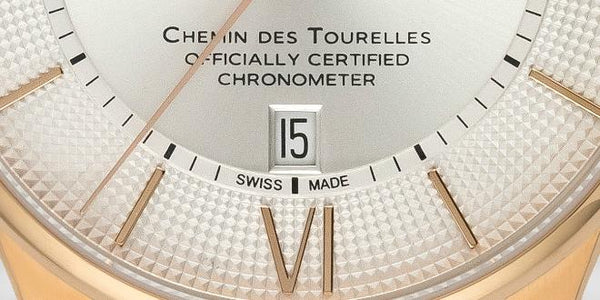
“What does the watch connoisseur mean by that?”
That a watch should display the time as accurately as possible sounds trivial at first. But what demands are actually placed on accuracy in practice, and which deviations are still considered acceptable? And what is the frequently mentioned COSC certification all about?Accuracy and Timekeeping Error
Accuracy can be defined as a statement of a watch’s timekeeping error. This error corresponds to the deviation between the time displayed by a watch and a so-called time standard, which serves as the reference. In practice, the time standard is provided by clocks that run extremely precisely and can therefore be used for setting other timepieces. This process is also known as calibration. Technically, the time standard is always the time display that, according to the current state of the art, has the smallest rate error. At present, these are so-called atomic clocks.

Every country has a specific institution responsible for the time standard. In Germany, this is the Physikalisch-Technische Bundesanstalt (PTB), based in Braunschweig, while in Austria it is the Federal Office of Metrology and Surveying (Bundesamt für Eich- und Vermessungswesen). In Switzerland, responsibility for the time standard lies with the Federal Institute of Metrology. The more the displayed time deviates from the time standard, the greater the timekeeping error.
Clock Offset and Rate
The timekeeping error can be constant, but this is by no means always the case. Deviations of the displayed time from the time standard can also steadily increase or decrease, or vary. If the deviation remains constant over a longer period, watchmakers call it the clock offset or setting error. In such a case, the timepiece itself works flawlessly; it has simply been set to a time that differs by a certain amount from the desired reference time.
The offset is always stated as the correction that would have to be made to obtain the reference time.
A watch running 15 seconds slow, for example, has an offset of +15 s, because 15 seconds must be added to the displayed time to get the correct time. If the movement runs fast, the reverse applies. The offset must be distinguished from the rate, often simply called the “going.” The rate represents accuracy in the true sense and indicates the decreasing or increasing deviation of the displayed time from the time standard over the course of a day. If you observe this deviation over a longer period, you can determine the average daily rate.

Fluctuations in the rate, that is, the difference between the daily deviations, are called rate variations by specialists. A rate variation can have various causes. Dirt and wear in the movement are just as likely culprits as certain external influences, such as changes in air pressure or temperature. The position in which a watch constantly rests, or the way it is worn, can also affect its daily rate. Over the centuries, the effort to keep rate deviations as small as possible has led to a series of technical innovations and a wide range of measures to shield movements from external influences. In high-quality mechanical models with gear trains, watchmakers try to offset unavoidable external influences and the resulting rate errors by means of so-called compensation.
Radio-controlled watches do not require such measures, because their correct time is readjusted at regular intervals by a time signal transmitter.
Power Reserve and Accuracy
The power reserve should not be confused with a watch’s accuracy. The power reserve, or running time, corresponds to the period between fully winding a mechanical watch and the moment it either needs to be rewound or stops if it is not wound in time.

Nevertheless, there is a connection between the power reserve and possible inaccuracies in timekeeping. Experience shows that mechanical movements run more accurately the more consistently the mainspring tension stays in the middle range. To ensure high precision, it is therefore advisable not to run the remaining reserve down, but to wind the watch as regularly as possible so that the mainspring is ideally never fully wound or fully unwound. A self-winding movement is particularly practical in this respect, as it comes relatively close to this ideal if the watch is worn regularly and kept on a watch winder when not in use.

A power reserve indicator on the dial is a popular complication on mechanical wristwatches and, against this background, is by no means merely decorative but offers very real practical benefits.
The Chronometer Certificate – the “Knighthood” for Exceptionally Accurate Masterpieces
In most everyday situations where the time matters, seconds are less important than hours and minutes. Even so, exceptionally high precision is an important quality feature of wristwatches, because rate deviations of just a few seconds per day can add up to minutes over time and increasingly impair the accuracy of the time display.

So that precision could be tested and certified by a neutral third party, so-called chronometer trials became established as early as the 17th and 18th centuries, initially conducted mostly by observatories. Until the development of the wristwatch, it was primarily marine chronometers that underwent such testing. These were timepieces used for navigation at sea, and their precision had to meet particularly high standards. Today, by contrast, the term “chronometer” is also used for wristwatches, provided they meet the relevant testing criteria. Numerous renowned luxury watch manufacturers such as Breitling, Tag Heuer and Omega currently offer chronometers in their collections.

At Rolex, chronometer testing is even standard for all Rolex watches, but there are also manufactures such as IWC, Breguet and a few others that forgo testing even though their products would meet the criteria.
Accuracy by COSC: Testing Bodies and Chronometer Criteria
In Switzerland, chronometer testing is carried out today by the Contrôle officiel suisse des chronomètres (COSC), which was formed in 1973 through the merger of several semi-governmental and private laboratories. Contrary to what the name suggests, it is not an “official” testing body in the sense of a state institution, but an association under Swiss law, supported by five Swiss cantons (Bern, Geneva, Neuchâtel, Solothurn, Vaud) together with the Federation of the Swiss Watch Industry, and it is widely recognized as a testing authority.

In Germany, too, a chronometer testing center has existed in Glashütte since 2006, operated by Wempe KG. The limits applied to mechanical wristwatches correspond to those COSC uses for its chronometer tests in Switzerland, while the criteria for quartz watches differ somewhat. A complete description of the testing procedure would go too far here, but a few details on the test duration, procedure and selected permissible limits already give an idea of the demands that watches and movements must meet to earn the coveted COSC certificate and be allowed to bear the prestigious reference to it on the dial.

For mechanical models, the entire testing procedure takes 15 days; for quartz watches, it still takes eleven days. For watches with manual-winding or automatic movements, rate deviations are measured in five different positions at three different temperatures. For movements with a diameter of more than 20 millimeters, the mean daily rate may not exceed two seconds; for smaller movements, a maximum of 3.4 seconds per day is allowed. In addition, six further limits must be met for the movement to pass the test successfully.