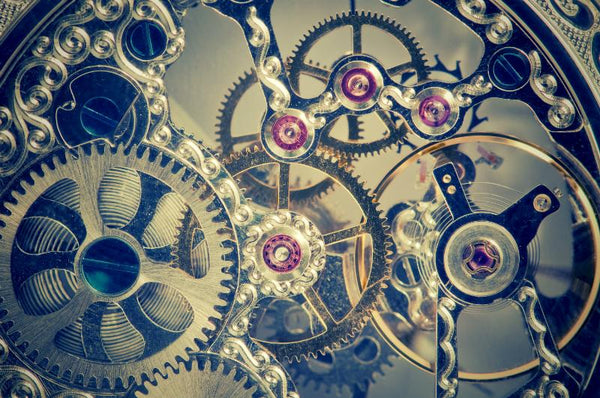
« Masterpieces from the Valley of Swiss Luxury Watches »
For watch connoisseurs, the Vallée de Joux is a valley with a meaning all its own. What comes to mind is not primarily ski slopes or hiking trails, but one of the birthplaces of today's world-famous Swiss watch industry. Visitors to the Vallée de Joux will find tourist highlights and breathtaking natural scenery, as well as important landmarks in the history of Vallée de Joux watches.
The Vallée de Joux in the Swiss Jura – a Secluded High Valley
In an Alpine country like Switzerland, there is truly no shortage of valleys and mountains. Yet anyone getting a first impression of the Vallée de Joux's topography may rightly wonder why two of the oldest and most storied Swiss luxury watch brands are headquartered here of all places. While other industrial locations stand out for their convenient transport links and easy accessibility, the Vallée de Joux certainly scores with its scenic charm but is otherwise somewhat off the beaten path.

The Canton of Vaud, in whose territory it lies, is part of the Geneva-Lausanne metropolitan region, yet the high valley, situated at an elevation of around 1,000 meters in the Swiss Jura, is completely enclosed by the surrounding mountains. It is first mentioned in a document dating from 1334, which refers to a "valle lacus juriensis." The name alludes to the fact that the northeastern part of the valley, through which the Orbe River flows, is home to two lakes, Lac de Joux and Lac Brenet, the former being the largest lake in the entire Jura. That such a large body of water could form at this altitude at all is due to the fact that the entire valley floor was once covered with clay deposits by Ice Age Jura glaciers, effectively sealing it.
Altogether, the valley, which runs from southwest to northeast, is about 20 kilometers long.
While the broad, flat valley floor is mostly between one and at most one and a half kilometers wide, the entire basin, including the adjoining slopes, measures roughly four to five kilometers across. Given its remote location, it is believed that in earlier centuries the valley was an impenetrable wilderness, and that people probably did not set foot in it until the sixth century. Even so, there was likely hardly any significant settlement until the ninth century. Large-scale land clearing began only with the monks of a Premonstratensian abbey founded in 1126 on the eastern shore of Lac de Joux.
Agriculture Shaped the Valley for Centuries
Because of its altitude, the Vallée de Joux has a comparatively harsh climate, and despite its size, Lac de Joux freezes over relatively quickly. On January 31, 1888, a temperature of minus 41 degrees Celsius was recorded in the valley. Average precipitation, however, is lower than on the ridges surrounding the valley. Due to the climatic conditions, the valley's inhabitants have always practiced extensive farming, but they also turned to fishing.

In search of additional sources of income, the extensive forests began to be managed in the 15th century, and in the following century regular timber exports from the valley got underway. Forges, hammer mills, and sawmills were subsequently established. Another branch of the economy was charcoal burning, particularly in Les Charbonnières, whose name still recalls this trade.
The First Vallée de Joux Watches Come to Market
Industrial activity in the Vallée de Joux initially focused mainly on the production of wooden vessels and metalworking. Then, in the 18th century, the industry arrived that would make the name of this once unknown, remote valley famous around the world: Swiss watchmaking. As in other Swiss locations, the focus at first was on cottage work, carried out mainly by the region's farmers during the winter months to earn extra income.
Only later were several watch factories founded in the Vallée de Joux.
Since then, the valley has been an indispensable part of the places where Swiss luxury watches are made. Microtechnology and precision engineering remain the defining industries of the local economy to this day, as the valley is home not only to watchmakers but also to highly specialized suppliers to the watch industry and to gemstone-processing businesses. The great names of the Swiss luxury watch industry to whom Vallée de Joux watches owe their fine reputation to this day, and which have a special relationship with the valley, include above all Breguet, Audemars Piguet, and Jaeger-LeCoultre. The name Blancpain is also frequently mentioned in this context, as this manufacture is likewise located in the region.
Breguet and Blancpain – Two of the Oldest Swiss Luxury Watch Manufactures
The names Breguet and Blancpain are familiar to history-minded watch connoisseurs not only for their exclusive watch collections; they also stand for two of the oldest brands in the field – and for some of the most exclusive masterpieces of the Swiss luxury watch industry. Founded in 1735, the Blancpain manufacture, now part of the Swatch Group, took its first steps toward series production as early as 1815. In 1926, Blancpain caused an international sensation when, together with John Harwood, it presented the world's first wristwatch with automatic winding. To this day, the manufacture prides itself on never having produced quartz watches.


Nor does it intend to do so in the future. Among Blancpain's best-known models is undoubtedly the legendary Fifty Fathoms dive watch. The Blancpain 1735 is also considered one of the most complicated wristwatches ever made. Its features include automatic winding, a tourbillon, a minute repeater, a split-seconds chronograph, and a perpetual calendar. It is produced in just 30 pieces, with annual output of only a single watch.


The Breguet brand is now based in L'Abbaye and likewise belongs to the Swatch Group, but for a long time it was headquartered in Paris. It was founded in 1775 by watchmaker Abraham Louis Breguet, who early on caught the industry's attention with self-winding mechanisms, pocket watches with an integrated gong, and the "pare-chute," a forerunner of today's shock-protection systems. Breguet also made horological history by inventing the tourbillon and building the world's first wristwatch in the early 19th century. Today, Breguet's creations rank at the very top even within the luxury segment and often sell for six-figure prices. They include such exclusive models as the Classique, whose moon-phase calendar reliably displays the current phase of the moon for 1,050 years.
A Rewarding Destination for a Watch Lover's Vacation
Since the 1970s, the Vallée de Joux has also become increasingly important as a tourist destination. It offers excellent opportunities for a variety of summer and winter sports and is as inviting for water sports as it is for long hikes on the surrounding Jura heights. In winter, the region is especially popular with cross-country skiers.
And if you are interested in watches, you should not miss the chance to combine your vacation in this fascinating valley with a visit to the "Espace horloger" watch museum in Le Sentier.
There you will find numerous interesting Vallée de Joux watches from various brands based in the valley, including some with exclusive complications that rank among the finest achievements of Swiss watchmaking.