Gold – for thousands of years, this lustrous precious metal has held an unrivaled fascination for people. Coveted as jewelry and prized as an investment, it plays a special role in the watch industry. But just because a watch has a golden gleam doesn't mean it's a "real" gold watch. We explain the different kinds of gold watches, what to consider in terms of price and value, and which models are especially sought after.
Solid gold or gold-plated? The terms you should know
A gold watch can get its shine in one of two ways: either it has a stainless steel case coated with a thin layer of gold, or the case is made of solid gold. The first is referred to as gold plating, while the solid gold version is what's usually called a "real" gold watch.
The word "real" is deliberately in quotation marks: when high-quality models are gold-plated, the coating consists of the genuine material and not some other substance.
However, gold plating is usually extremely thin – the marking "10 microns" on the caseback, for example, means the gold layer is 0.01 mm thick. This makes it clear that plating uses far less of the expensive metal.


Turning to the "real" models, you'll often come across the unit "karat" for the gold content. One karat (kt) means "one part in 24." Accordingly, 24-karat gold means the alloy consists 100% of the precious metal, although since perfect purity is never achieved, the figure given is 99.99%. A "real" gold wristwatch can contain varying proportions of the metal, with 18 kt (750 gold), 14 kt (585 gold) and 8 kt (333 gold) being the most common. So even within the "real" category the differences are considerable – yet they hardly explain the price differences:


The Tissot T-Gold collection, for example, offers 18 kt models starting in the low four figures, while considerably more expensive watches from other brands often use 585 alloys.
Yellow, rose or white gold: plenty of variety
Although a gold watch is usually associated with yellow gold, rose gold and white gold offer elegant alternatives. To take a closer look at the different types and how they differ, the Rolex Cosmograph Daytona is an excellent example, since this legendary chronograph is available in every conceivable variation – the case, bezel and bracelet can each be made of the regal metal or not.


If you want to make a statement, yellow or rose gold is your best bet, while white gold has a more understated look. Hard for laypeople to tell apart from silver, it is a special alloy whose golden color has been removed by adding other precious metals.
Interestingly, because it's more difficult to work with, it's even more expensive than "regular" gold.
If you want your luxury watch in gold, you face a tough decision, since almost every manufacturer offers its classics in a gold version.


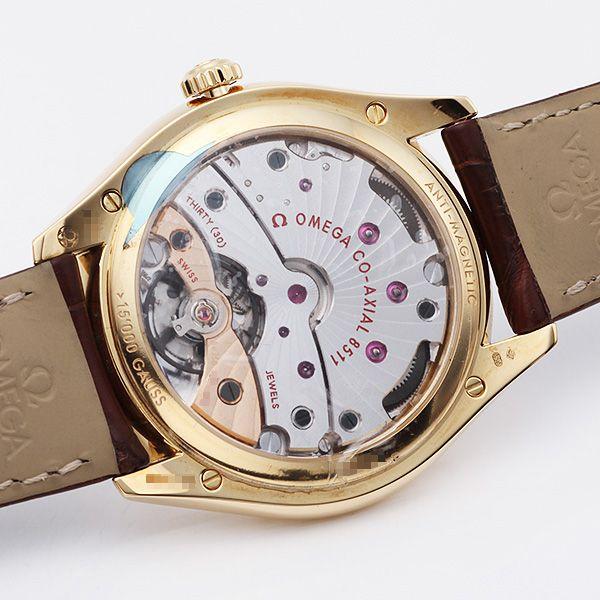
The Omega De Ville as a solid gold watch is especially stylish, since the model already cuts an excellent figure at formal occasions. As with all other manufacturers, however, it carries an enormous premium over the steel editions.


That's why vintage models, such as the Omega Constellation, are considered an insider tip among lovers of the precious metal, as well-preserved masterpieces can be had for much less than new watches.
The premium on gold watches: why is it so high?
Whether in a shop window or online: when you look at luxury watches from various brands, the huge price gap between steel and gold watches jumps out immediately. The Rolex Cosmograph Daytona in gold, for example, costs around three times as much as the steel model.
With the Omega De Ville, you should even expect five times the price. With differences like these, it's clear they can't be attributed solely to the higher material cost of gold.
Two further factors explain it: on the one hand, the more demanding manufacturing; on the other, deliberate exclusivity. Since gold is naturally much softer than steel, special techniques are needed to work the material and build the watch. Almost even more important is exclusivity – part of the premium is simply what you pay to own something rare that few others can afford.
The gold watch as an investment – better than "ordinary" timepieces?
For collectors and investors in particular, the question arises of how gold watches hold their value – could the high premium over steel watches pay off one day? Unfortunately, no reliable answer is possible, since a model's market value depends on many other factors.

Demand is the decisive factor: rare, coveted models rise in value regardless of material, while solid gold watches produced in large numbers can lose value. The Rolex Cosmograph Daytona, for example, is one of the most sought-after timepieces of all, and its steel models have appreciated sharply in recent years. A gold Omega Constellation belongs more to the second category – it's made in large numbers, and an increase in value anytime soon seems unlikely.

So it's strongly advisable not to buy just any gold watch in the belief that it will appreciate anyway. In the worst case, you won't even get the material value back. If you're interested in wristwatches as an investment, it pays to dig deeper – those who gain experience and develop a feel for the market will tend to be more successful than beginners. Regardless of the material.