« 18 Karats for Omega Watches »
The modern watch industry's capacity for innovation seems unstoppable: after the 21st century had already produced a wealth of new complications and creative designs, manufacturers began reinventing materials a few years ago. A prominent example is Omega's Sedna Gold, which is meant to give the precious metal a new luster, richer color, and a more exclusive aura. But other manufacturers are also already relying on proprietary watch materials in the luxury segment.
Three Elements, One Goal: Optimal Properties
According to Omega, Sedna Gold draws its inspiration from a realm the storied Swiss brand knows well from its own history – outer space. However, the material's name refers neither to the edge of space nor to the Moon, as one might assume given the records of the "First Omega In Space" and the legendary "Moonwatch." Instead, it refers to a dwarf planet named Sedna, which travels along the outermost fringes of the solar system and is exposed to near-total darkness. Just how far this body is from the Sun becomes clear in the following comparison: while the outermost planet, Neptune, takes about 165 years to orbit our star, Sedna takes more than 11,000. Admittedly, the origin of the name is a bit fanciful.
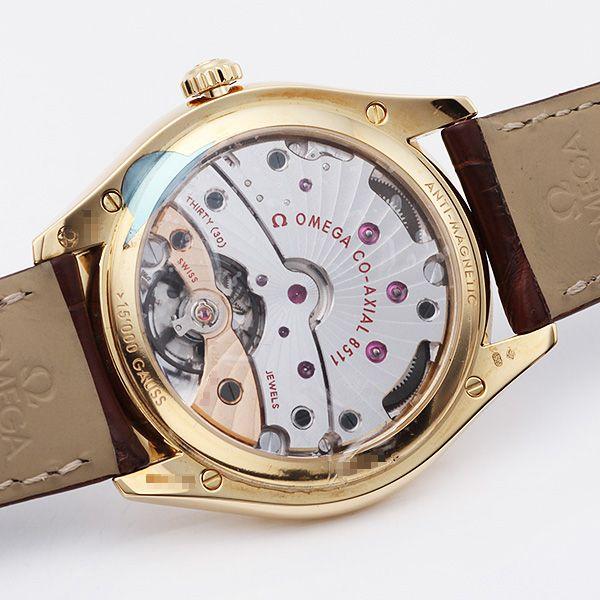
Yet its composition of 18-karat (i.e., 75 percent) rose gold, palladium, and copper offers a good explanation for the cosmic name: the copper gives the reddish material a particular depth of color, much like the dwarf planet orbiting in the deep black of the universe. The palladium, by contrast, is used for its exceptional hardness – making Sedna roughly three times more resistant overall than other rose gold alloys used in the watch industry.
The Models That Use the Material
Since its debut in the Constellation unveiled in 2013, the material has seen growing demand despite the hefty premiums over comparable stainless steel models. It's no surprise, then, that the alloy is now available across several collections from Biel/Bienne. In what is arguably its purest form, it still graces the Constellation line, whose simplicity naturally puts a strong focus on the watch materials rather than on complications. But the De Ville collection, with its Omega Ladymatic series, also gives the material a lasting presence – one that is, of course, most pronounced in solid gold cases.
At the opposite end is the limited Moonwatch Apollo 11 45th Anniversary, on which only fine details such as the hands, indices, and bezel edges appear in Sedna Gold. It shows that this distinctive alloy can make a lasting impression even on a small scale – so you don't have to invest enormous sums in solid gold cases to experience its reddish glow for yourself. If you'd still like the full version, take a look at the Seamaster 300 in Sedna Gold: its black contrasts on the bezel and dial, along with its moderate size, show off the material beautifully.
Ceragold: The Complex Symbiosis with Ceramic
As an exotic variant of the precious metal, Sedna is by no means alone in the Swatch Group brand's production facilities. Since 2012, the manufacturer has also used the so-called Ceragold process, which centers on coating ceramic bezels with the coveted precious metal. What sounds simple at first required years of research and development: after being hardened at around 1400°C and having their scales laser-engraved, the ceramic rings must be coated with a conductive layer and immersed in an electrolytic gold bath for 48 hours. There, an 18-karat gold layer forms around the entire bezel, which is then reduced until only the recesses of the numerals and markers retain their gold layer.


The Seamaster Planet Ocean 600 M demonstrates why all this effort pays off: not only a perfectly smooth bezel surface but also greater contrast between the black ceramic and the gold scale, compared with a simple applied finish, justify the complex process. You might think this impressive expertise in working gold would give the Swiss brand an edge over rival manufactures. But Omega's competitors aren't sleeping – they have been driving innovative uses of the precious metal themselves for decades.
Rolesor and Magic Gold: Creativity Is What Counts
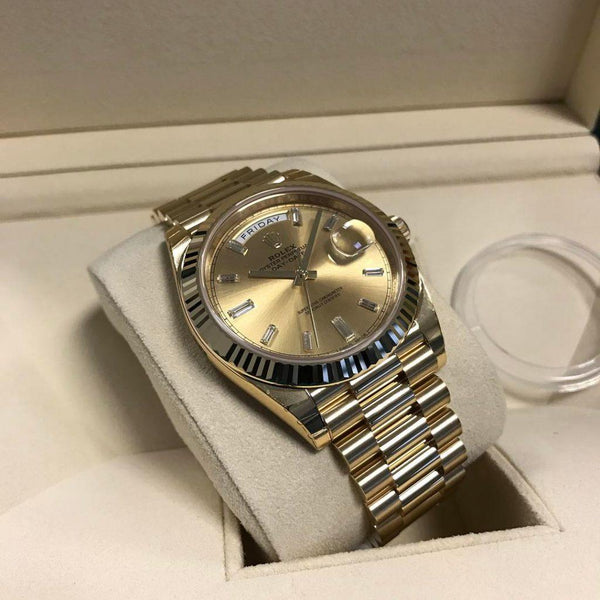
Rolex in particular – for many enthusiasts the epitome of prestigious gold watches – has long been well versed in the clever use of its alloys. Back in 1933, the Geneva manufacturer trademarked the term Rolesor, which simply describes the combined use of gold and stainless steel components in the same watch. The concept is simple: while the bezel, winding crown, and center links of the bracelet are made of gold, the remaining components use the brand's in-house "Oystersteel." The result is a well-balanced middle ground that is less opulent than a full gold version yet more appealing than one hundred percent stainless steel.


When it comes to technical excellence rather than visual composition, however, Hublot's Magic Gold proves to be the leader. Unlike Sedna Gold, it is not copper or palladium but platinum that is added, making it the most scratch-resistant gold alloy in the watch industry. Polished ultrasonically, it reveals the individual particles of the alloy on close inspection and undergoes an extremely complex manufacturing process – so only a few Magic Gold models can be produced per day. It's a truly fascinating material. Like Omega's Sedna, it clearly illustrates the industry's current transformation – never before have technical innovation and diversity carried so much weight in horology. We can look forward to seeing which materials will grace our wrists in the future.