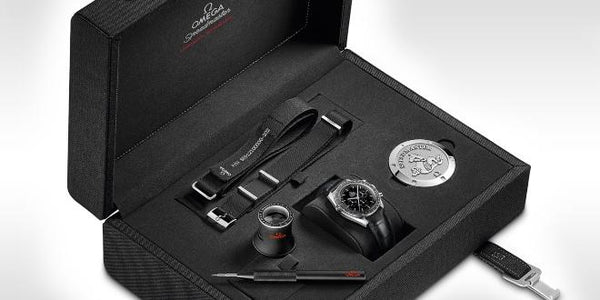
« We help you decide »
Two icons, one decision: at some point in their collecting journey, most watch enthusiasts face the tough choice between the Omega Seamaster and the Speedmaster. And for good reason: both collections are almost unmatched in historical significance and set the benchmark for quality in their price range. We introduce the key models from both families, explain their respective strengths, and help you make the best choice between Seamaster and Speedmaster.
A broad spectrum on both sides
When people talk about the Omega Seamaster or Speedmaster, they are by no means referring to a single model. Both names are umbrella terms for several sub-collections, some of which differ considerably from one another. Alongside the famous Moonwatch, the Speedmaster line includes eight other series, ranging from the compact 38 mm edition to the unconventional Mark II with its streamlined case. The Seamaster offers a refreshing variety as well: in addition to the popular Diver 300M – the next James Bond watch in "No Time to Die" – it is home to seven other editions, including the elegant Aqua Terra 150M and the high-performance Planet Ocean.


The most important distinction between the Seamaster and Speedmaster lies in how the two families are positioned. While the Seamaster has been built for water resistance and durability since its debut in 1948, the Speedmaster, introduced in 1957, was designed as a sports chronograph with a tachymeter scale for racing drivers. It found its way to NASA more or less by chance, first traveling into space in 1962 on the Mercury-Atlas 8 mission and later, as part of the Apollo 11 mission, becoming the Moonwatch we know today. These fundamentally different histories are reflected in the character of today's Seamaster and Speedmaster models: simplicity and pressure resistance on one side, finely detailed scales and focused design on the other.
The elegant ones: Aqua Terra 150M vs. Speedy 38 mm
Sporty doesn't have to mean oversized or extreme. Both the Omega Seamaster and Speedmaster come in a range of timeless editions, among which the maritime Aqua Terra 150M is a true classic. Take the popular Ref. 220.13.41.21.03: striking a balance between a capable diver and an elegant dress watch, this 41 mm men's watch features a deep blue dial with a horizontal "teak" pattern. For fans of mechanical movements, its sapphire caseback offers an unobstructed view of the caliber 8900, a METAS-certified movement with a 60-hour power reserve. Top-tier quality meets a decidedly harmonious case and a symmetrical dial with a simple date display.

Less harmonious and simple, but considerably more powerful and equipped with a chronograph function: that's the Speedmaster 38 mm. If you can do without a display caseback and METAS certification, it gives you a sportier, more functional alternative to the 150M. Defined by its compact diameter, it is ideally suited to slimmer wrists and stands as a series in its own right alongside its big brother with the Apollo heritage. Our favorite is the black Ref. 324.30.38.50.01, which, like its sister models, is powered by the automatic caliber 3330 with a silicon balance spring.

The classics: Diver 300M vs. Moonwatch Professional
Now for the big stars of the Omega Seamaster and Speedmaster collections. Neither the Diver 300M nor the legendary Moonwatch Professional lacks toughness: while the former features a helium escape valve and is rated to a depth of 300 meters, the latter remains to this day the only watch certified by NASA for spacewalks. Here, choosing between Seamaster and Speedmaster is purely a matter of taste: a burly diver or a finely detailed chronograph? What's certain is that both editions rank among the best timepieces on the market in their respective fields. Take the 42 mm Seamaster Ref. 210.32.42.20.04: its unmistakable wave pattern on the white dial and its skeletonized hands create a look that stands out even in the world of dive watches. Equally at home with Agent 007's sharp suit and a relaxed casual outfit, the Diver is considered one of the best all-rounders in the entire watch industry.

Its history of more than 70 years is impressive, too, but it can't match the prestige of the Professional. It was the Professional that set foot on the Moon on all six of NASA's successful lunar missions. And it was the Professional that helped the Apollo 13 crew return safely to Earth after their catastrophic technical failure. Take the classic Ref. 311.30.42.30.01: visually almost unchanged from the historic original, it is powered by the manual-winding caliber 1861 and features the three subdials that made the 42 mm model famous: small seconds, a 30-minute counter, and a 12-hour counter in perfect arrangement.
The extremes: Ploprof vs. Mark II
Many enthusiasts, however, prefer not the classics but the more unusual members of the Seamaster and Speedmaster collections. If you want to take the concept of an uncompromising dive watch to the limit, look no further than the gigantic Ploprof 1,200 M: measuring 55 x 48 mm, its titanium case catches the eye with a massive crown guard on the left and a solid counterweight on the right. Since its introduction in 1970, the Ploprof name has stood for Omega's most water-resistant timepieces, where sheer performance and ultimate toughness take center stage.

The Speedy Mark II also sets itself apart from the series' usual standard with its case shape. Launched in 1969, its streamlined design does away with classic lugs and, unlike the Professional, fully encloses the tachymeter scale. It measures 42.4 x 46.2 mm. It is powered by the proven Co-Axial caliber 3330. Unlike the Ploprof, it is not meant as a demonstration of extremes, but rather as a visually and technically modified version of the regular Professional.
Conclusion: Omega Seamaster or Speedmaster?
If you're thinking about buying a Seamaster or Speedmaster, don't rush your decision: both series shine with their own distinct advantages and, depending on the collection, suit different lifestyles. Because the selection is large and the price difference between Seamaster and Speedmaster is usually small, it pays to narrow down your favorites step by step. Given the broad range of both series, however, there's no blanket answer as to whether the Seamaster or the Speedmaster is the better fit. One thing is certain, though: with both collections so well balanced in function and aesthetics, it's almost impossible to make a truly bad choice.