“Love at Second Sight”
When people talk about luxury watches today, they usually mean mechanical watches with automatic or manual winding. Yet a number of renowned watch manufactures – including Breitling, Chopard, Omega, and TAG Heuer, for example – offer quartz models alongside their high-end mechanical luxury watches. The fact that quartz watches are in the minority in the luxury segment today – quite unlike the watch market as a whole – and that watch enthusiasts often see them as a case of "love at second sight" has historical roots.
A Look Back: The Rise of Quartz Technology
Achieving ever greater accuracy, and with it the most precise timekeeping possible, has always been a central goal of watchmakers. To get ever closer to this goal, they developed countless innovations over the centuries. Among them were important milestones in horological history, and some of these technical solutions remain relevant in practice to this day.
Few innovations, however, have had such far-reaching consequences for the entire watch industry as the development of the quartz watch.
The technical groundwork was laid as early as the 1920s in connection with research into high-frequency technology. The world's first quartz clock was presented to the public in 1927 by Joseph W. Horton and Warren Alvin Marrison. Early versions, however, were only rarely used as timepieces; instead, they served mainly as laboratory equipment and measuring instruments for scientific experiments.

After World War II, quartz clocks became the industrial and scientific standard, replacing the precision pendulum clocks used until then. Early attempts to develop portable quartz timepieces failed because the vacuum-tube electronics they relied on consumed too much power, but in the late 1950s the Swiss watch manufacture Patek Philippe succeeded in producing the first practical quartz wristwatches. This was made possible by semiconductor technology and new types of synchronous motors; in addition, reliable batteries had become available by then.

In 1960, Patek Philippe finally launched the Chronotome, the first portable battery-powered quartz clock, produced in a small series. Similar models from Seiko and Junghans followed shortly afterward. At the time, all of them were still considerably more expensive than high-quality watches with mechanical movements.
The Quartz Watch Goes Mass-Market
Around 1970, advances in microelectronics made it possible to produce the first quartz timepieces for the mass market. This led to a rapid drop in prices, particularly for car clocks, desk clocks, and wall clocks. By the mid-1970s, quartz clocks were already cheaper than mechanical ones. At the same time, timepieces based on quartz technology were far more accurate and, apart from the occasional battery change, virtually maintenance-free.
 After a certain delay, the same development took hold in the wristwatch segment as well.
The Quartz Movement Goes into Series Production
As early as 1967, quartz wristwatches had attracted considerable public attention when prototypes submitted by the Swiss Centre Electronique Horloger (CEH) and the Japanese watchmaker Seiko proved superior to all of the mechanical competitors at the chronometer competition of the Neuchâtel Observatory.
Thanks to temperature compensation, the Swiss entries achieved even better results than their Japanese rivals. Seiko, however, had set its sights on eventual mass production from the very beginning and, at Christmas 1969, sold the Astron, the first small series of quartz wristwatches.
At the time, though, a single watch cost roughly as much as a small car.
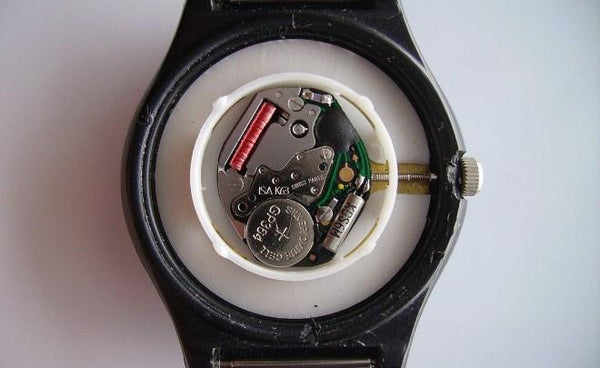
Once Seiko had brought three key technologies – still used in virtually every analog quartz watch today – to production readiness by 1972/73, Japanese watchmakers' dominant position in the quartz segment was firmly established. The three decisive technological components were the photolithographically produced tuning-fork quartz resonator, the stepper motor, and the CMOS integrated circuit.

For quartz watches with digital displays, early experiments with light-emitting diodes (LEDs) soon gave way to energy-efficient liquid crystal displays (LCDs).
Prices Fall
By the mid-1970s, quartz wristwatches were already selling for less than 100 deutschmarks, and prices continued to fall quickly. As a result, mechanical movements were no longer competitive in the wristwatch segment either, in terms of both quality and price. Because many traditional watchmakers, especially in Switzerland, recognized this trend too late or failed to adapt their corporate strategy in time, the so-called quartz crisis ensued.
The Swiss watch industry, which had largely dominated until then, lost significant shares of the wristwatch market to its competitors from the Far East.
These competitors flooded the market with ever cheaper quartz watches and also outperformed the competition in terms of accuracy. Inevitably, many long-established companies in the industry ran into financial trouble in the 1970s and 1980s and either had to close or merge into larger groups.
Quartz Watches and Luxury Watches – Still No Contradiction Today
As the quartz watch increasingly became a mass-market product, renowned Swiss watch manufactures repositioned mechanical wristwatches as luxury products. This strategy ultimately proved successful: Swiss companies are now the global leaders in this market segment. Nevertheless, almost all of the big names in the Swiss watch industry have also developed high-quality quartz watches, and most of them continue to offer them.

How quartz models are positioned, and what share they make up of the individual product lines and collections, varies from brand to brand, however. At Chopard, for example, the share of watches with quartz movements is relatively high, while it is considerably lower at brands such as Omega, Breitling, and TAG Heuer.

While a few premium and luxury watch collections, such as the T-Touch from Tissot or Breitling's Chronospace models with analog and digital displays, are available exclusively as quartz versions, watches such as the Longines Hydroconquest, the Omega Seamaster Aqua Terra, and various TAG Heuer Formula 1 models come in both quartz and automatic versions.

In some cases, you can only tell them apart at second glance – for instance, by the lettering on the dial or by whether the seconds hand sweeps smoothly or moves in steps.
Rolex Has Gone Its Own Way Since 2001
Rolex, incidentally, chose a different path. With the Oysterquartz Datejust and the Oysterquartz Day-Date, available in various versions, the manufacture did bring quartz watches to market and kept them in its lineup for around two decades, but that era ended in 2001.
Since then, Rolex has focused exclusively on mechanical luxury watches.
The quartz models bearing the crown on the dial, however, are still present on the collector's market and at auctions, where they regularly fetch high prices. All in all, quartz watches have a well-deserved, firm place in the luxury segment – even if they account for only a relatively small share of the market there. And what luxury is or means is something everyone can decide for themselves anyway.