« Home of Certina, Mido, Tissot, Ulysse Nardin and Zenith »
It is considered the cradle of Swiss watchmaking, has been a UNESCO World Heritage Site since 2009, and is still home to some of the industry's most important manufacturers, including Tissot, Ulysse Nardin, Zenith and Certina: the municipality of Le Locle in the canton of Neuchâtel fascinates in many ways. Few places have been so closely tied to the watch industry throughout its history. Let's take a tour of this storied town and discover some of the prominent brands whose success began there.
Where Industry Meets Culture
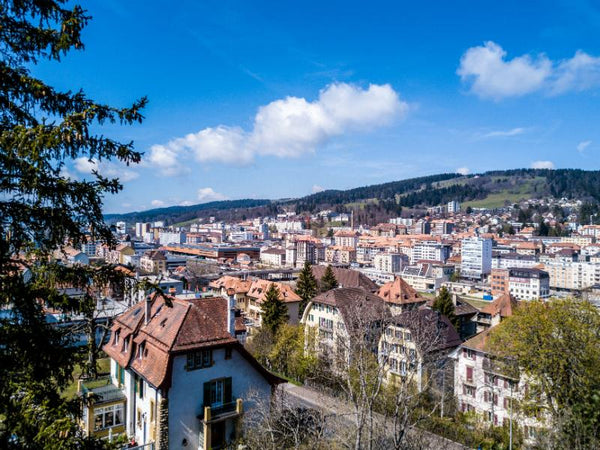
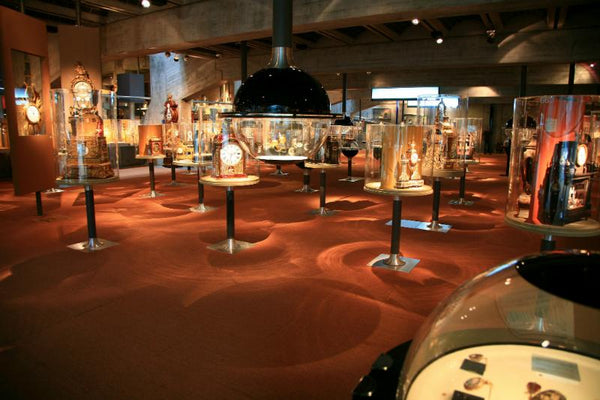
The watchmaking town lies in northwestern Switzerland, right on the French border and about 80 kilometers by road west of Bern. Just eight kilometers away is La Chaux-de-Fonds, also famous for its watchmaking, whose history closely mirrors Le Locle's development. Set the famous industry aside for a moment, and this small town of around 10,000 residents turns out to be a true treasure trove for culture lovers: in addition to three museums, among them the watch museum and an art museum with constantly changing exhibitions, its distinctive grid-pattern townscape is a delight.

Numerous Neo-Renaissance buildings and the imposing former town hall bring to life a sense of Swiss coziness as well as the spirit of centuries past. First mentioned in records around 1150, Le Locle went through its greatest period of development from the early 18th century onward. In 1705, the goldsmith and watchmaker Daniel Jeanrichard began making timepieces there, laying the foundation for the industry that followed.
Some 100 years later, as the shift from pure handcraft to industrial production succeeded, remarkable growth set in, giving rise to several of the watch brands that remain among the most famous today.
There was one drawback, however: because Le Locle sits in a basin, its room to expand remained limited – quite unlike neighboring La Chaux-de-Fonds, where growth was even more pronounced.
Global Brands with a Quiet Home
The contrast seems extreme: Tissot and Certina, two of the world's largest watchmakers, are headquartered in a town with only a tenth of the population of Germany's smallest major city. This shows that, despite belonging to the vast Swatch Group, both brands remain committed to tradition and their roots. That matters for both sales success and credibility – anyone who presents their watches as the product of centuries-old tradition has to clearly underscore loyalty to their own history.
Tissot once fit perfectly into Le Locle's almost rural way of life: in 1853, the company's founder of the same name opened a small workshop that assembled pocket watches from outsourced components. Impressed by the exceptional robustness of these timepieces, international customers demanded ever larger quantities – gradually expanding the business was inevitable. Finally, in 1920, the company decided to produce its own movements, which only accelerated its success.


Like Tissot, Certina is a global brand today – both names stand for Swiss quality at good value for money. Certina's beginnings, however, were not in Le Locle at all, but in Grenchen, some 60 kilometers away and now known as Breitling's headquarters. In 1888, the brothers Adolf and Alfred Kurth began producing movements and movement components there.
After decades of success, Certina unveiled a revolutionary invention in 1959 with its "DS" concept: the abbreviation stands for "Double Security" and refers to a screw-down crown that marked a significant advance in water resistance and durability.
Pioneering Spirit and Luxury
This was not the only innovation to come out of Le Locle: Mido, the heritage brand founded in 1918 and now also headquartered in the Neuchâtel town, took a major step in 1934 with the "Multifort" model. For the first time, four features – an automatic movement, water resistance, shock resistance and protection against magnetic fields – were combined in a single case. Mido, too, was not founded there but in Solothurn. Le Locle seems to have always had a magnetic pull – it stands not only for tradition but also for the human drive for progress, the will to keep getting better.
The pursuit of perfection has shaped the luxury manufacturers Ulysse Nardin and Zenith in particular. Zenith, founded in 1865 as the "Fabrique des Billodes," is known for building some of the most precise automatic movements of all. Rarely has the name of a caliber alone, "El Primero," achieved fame in its own right. As part of luxury goods group LVMH, the brand is another example of loyalty to its Swiss home and is one of Le Locle's most important employers.
For many watch enthusiasts, Ulysse Nardin is the epitome of the extreme: whether tourbillons, perpetual calendars or minute repeaters – if you want to marvel at the pinnacle of mechanical achievement, just look at the portfolio of the high-end brand with the anchor in its logo. Its history dates back to 1846 and shows that the watchmaking town has always been home to the industry's brightest minds.
An Essential Part of Watchmaking History

Our journey to Le Locle has shown that this town is more than just the home of watch brands such as Certina, Tissot or Zenith: the Neuchâtel municipality is a fascinating place full of innovation, cultural appeal and mechanical excellence. It has proven a magnet for some of the most important manufacturers of our time and is inseparably linked to the success of its manufactures – and of the entire industry.
And who knows – perhaps we wouldn't know the watch industry in all its diversity today if this town had never existed.
Another watchmaking capital: Our article on La Chaux-de-Fonds