« What Is It Good For? »
In the luxury watch segment, sapphire crystal is by far the most common material used to cover the dial today. Occasionally, however, you will also come across other materials such as Hesalite. In this article, we look at what it actually is and what special properties this material has.
The Watch Crystal – Key to a Watch's Quality and Durability
On historic tower clocks, the hands usually turn in the open air without any cover at all. That was never really a problem, and still isn't, because apart from the odd bird, nothing normally gets close enough to the hands to interfere with their movement or even damage them. It's a completely different story with watches carried in a pocket or worn on the wrist. Here, the hands and dial need special protection, because otherwise they would be scratched, bent, or otherwise damaged within a short time.

For a long time, the material of choice was ordinary window glass. While it offered a certain degree of protection, it was itself prone to breaking and scratching. These drawbacks of conventional glass were the main reason why many pocket watches were fitted with special metal covers to protect the crystal.

Watches with covers, however, are somewhat more cumbersome to handle, and you can't simply read the time at a glance. This, and not least the increasing displacement of pocket watches by wristwatches, drove watchmakers more and more to look for alternative materials for watch crystals. Hesalite and sapphire crystal are the results of this search.
Plastic Crystals Conquer the Market
The first watch crystals cut from plastic sheets came onto the market in the 1930s. Since the 1950s, they have mostly been injection-molded from granulate. Various terms were used for the different transparent plastics, some of them purely material names and some of them brand names. Examples include acrylic glass, Plexiglas – and Hesalite.
To distinguish "real" glass from these materials, terms such as mineral glass or silicate glass increasingly came into use.
By the 1950s and 1960s, watches with plastic crystals were nothing unusual at all. They were used as a matter of course in the luxury segment, too, since they were among the most modern and best materials of the time.
Sapphire Crystal Becomes Almost Standard on Luxury Watches
It was only with the further development of silicate glass that a countertrend gradually set in during the 1970s and 1980s. During this period, hardened mineral glass initially took hold, followed a little later by sapphire crystal, which has since become the near-universal standard on high-end luxury watches. Processes for chemically hardening silicate glass, available since the 1970s, make it possible to create a desired stress distribution within the glass. This makes it far less prone to breaking, compensating for one of the material's major drawbacks.

If you buy a watch with silicate glass today, you can be almost one hundred percent certain that it is at least hardened mineral glass. Its surface, however, is still susceptible to scratches. These are not only undesirable for aesthetic reasons but can, over time, also impair the view of the dial and thus the watch's legibility.

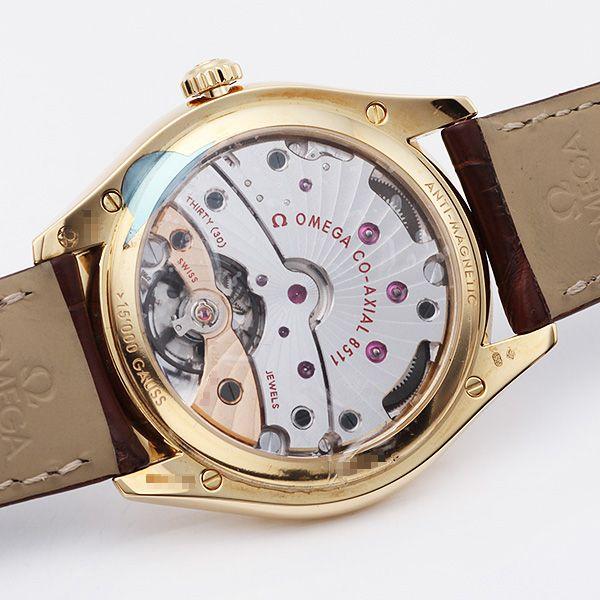
While scratches on plastic surfaces can be removed by polishing, this isn't possible with mineral glass. The only option here is to prevent scratching in the first place through extreme material hardness. For this, synthetic sapphires are used, produced from alumina under high pressure and intense heat. They are relatively expensive and difficult to machine, but practically immune to scratches. That's why high-quality watches are now almost always fitted with sapphire crystal, which on many models is also used for the caseback.
Why Hesalite Crystal at All?
Nevertheless, some luxury watch models are still fitted with plastic crystals today. Probably one of the best-known examples is the Omega Speedmaster Professional chronograph, famously known as the "Moonwatch." Given the material properties described above, this may seem hard to understand at first. In fact, plastic is mainly used for crystals in the lower price segment, because it can be produced cheaply and in large quantities.

Besides price, however, there are other important differences between materials like Hesalite and sapphire crystal. These include the plastic's lower weight, its lower brittleness and susceptibility to breakage, and its comparatively easy processing. These properties can certainly be in demand for luxury watches, too. Above all, though, they come into their own when a watch has to meet specific requirements because of its intended use.

This naturally applies in a very special way to an astronaut's watch like the Omega Speedmaster Professional. Glass splinters aboard a spacecraft would be far more dangerous than on Earth.
Inside a spacecraft, they would float around in zero gravity instead of falling to the floor. The risk of injury would be considerably higher than usual.
And during a "spacewalk," glass splinters could cut or puncture the spacesuit – with fatal consequences for the astronaut wearing it. These differences are why Hesalite and similar materials can still be found in the luxury segment today - and will likely remain there for quite some time.