« Among the materials used to make luxury watches, you will find "classics" such as stainless steel and gold, but also numerous exotic materials, chosen partly for aesthetic reasons and partly for their specific properties. Some materials were even developed specifically for the production of high-end watches. A central question is often whether a titanium or a stainless steel watch is the better choice. We present the properties of the various materials used in modern watchmaking. »
Luxury Watch Materials Through the Ages
Ideas about which material is particularly precious have changed again and again over the centuries – above all as a result of technical progress and depending on the availability of individual raw materials. The first wheel clocks made in Europe were built from iron and sometimes even from wood. Although no one today would associate either of these materials with luxury timepieces, the wooden clocks, for example, were works of extremely demanding craftsmanship, made almost exclusively for princes and high-ranking clergy. Later, during the Renaissance, brass, which was increasingly used to make clocks and movements, quickly gained importance. It remains an important base material for the watch industry today – though it is by no means limited to the luxury segment anymore.
Wood, Iron, Precious Metals, and Mother-of-Pearl
- Precious metals, especially gold, and gemstones, on the other hand, were already highly prized in antiquity and have kept their luxurious character to this day.
- Mother-of-pearl has likewise been crafted into valuable artisanal objects for many centuries and soon found its way into the production of high-quality watches, as the Tag Heuer Aquaracer demonstrates today.

- Mother-of-pearl is especially popular as a dial material, although it is sometimes replaced by less expensive imitations that at least create a similar visual effect.
- Naturally, gemstones are also found on luxury watches. Some models are true pieces of jewelry, with cases set with brilliant-cut diamonds or other precious stones. Diamonds are also used in places to mark the indices on the dial. The elegant high-end watches of the Chopard Happy Diamonds and Happy Sport collections are famous for their dancing diamonds.


- Beyond their aesthetic appeal, however, gemstones also serve a very practical purpose in mechanical watches: they act as jewel bearings that reduce wear and friction in the movement to a minimum. For many years now, though, synthetic rubies or other synthetic corundum have generally been used for this instead of natural stones.
Luxury Watches: Gold in All Its Variations
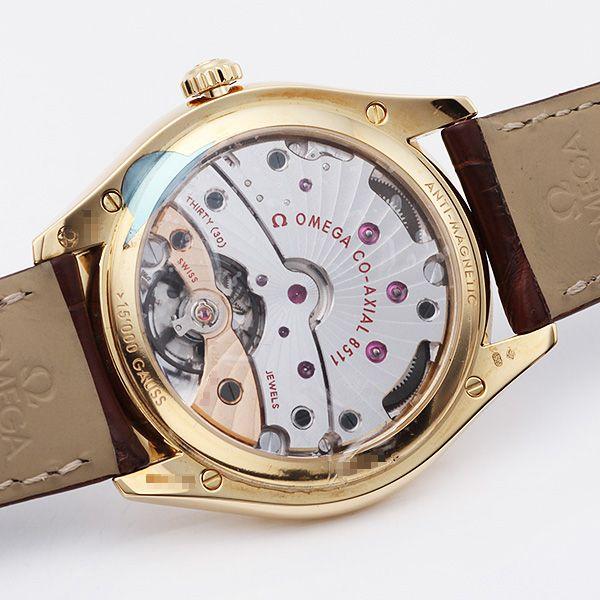
Today, alongside stainless steel, gold still plays a major role in the production of luxury watches. Many luxury watchmakers, such as Rolex or Omega, offer a range of top models in various gold alloys.

In some cases these are solid gold cases worn on leather straps, while in others the bracelets are made of solid gold as well. Besides classic yellow gold, watches in red gold – a gold alloy with a higher copper content – or in white gold are becoming increasingly popular.

A similarly colored alternative to white gold is the even rarer and more expensive platinum. Gold is sometimes combined with other materials, as in Rolex's Rolesor models. The manufacturer registered this name for its combination of gold and stainless steel as a trademark back in 1933, and it remains standard on several models among Rolex's new creations.
Titanium Watches Compared to Stainless Steel Watches
No list of high-end watch materials would be complete without titanium, which is valued far beyond the luxury watch segment, above all for its special physical properties. This material stands out in particular for its low weight combined with high strength, as well as its excellent corrosion resistance. The MÜHLE Glashütte Seebataillon GMT is one such titanium watch. Since the German Navy's naval infantry battalions already had plenty of equipment to carry, a lighter titanium version was chosen for the wristwatch. This material, too, is being further developed in the high-tech research of various watch manufactures. Breitlight, as used in the Breitling Avenger Hurricane 45, is 3.3 times lighter than titanium and 5.8 times lighter than steel – and harder as well – an impressive watch material.


Breitlight Instead of Titanium or Stainless Steel? New High-Tech Materials Conquer the Luxury Segment
Over the past few decades, however, new materials have repeatedly made their way into the luxury segment. Today, for example, it is entirely possible for a watch on a rubber strap to cost a four- or five-figure euro sum if it is a model from one of the internationally renowned Swiss watch manufactures.
Another still relatively "young" material for high-end watch cases is ceramic. After IWC and Rado launched the first ceramic watches in the mid-1980s, more and more new models and variants followed over the years. With a sapphire crystal coating, this material is not only light but also extremely scratch-resistant. While the first ceramic watches came in dark tones, Rado introduced the first all-white ceramic watch in the 1990s. Other colors have since become common as well, as the new and exclusive Rado True Thinline Les Couleurs™ Le Corbusier Spectacular Ultramarine 4320K impressively proves in blue.


Besides the Rado True collection, classics can also be found in the Chanel J12 with its sister models White Ceramic and Black Ceramic. The Bell & Ross BR 03-92 Ceramic is another popular ceramic watch.


One example of an entire collection of ceramic watches is the Force collection by Junghans, whose models are fitted with solar-powered radio-controlled movements.


Which Watch: Ceramic, Titanium, or Stainless Steel?
So what still speaks in favor of stainless steel today? Stainless steel has prestige, a long tradition, and a trustworthy reputation. Even so, titanium and ceramic watches are strong, temperature-resistant, and offer good properties in terms of ductility. Titanium and ceramic are harder than stainless steel and therefore stay looking good for longer. These materials are also suitable for people with allergies and impress with their refined look and feel. The only drawbacks lie in manufacturing, which is more complex and more expensive. However, if we compare the titanium watchmaker Rado with the stainless steel models of some luxury watch manufactures, this does not seem to affect the price. That said, anyone who manages to put a small scratch in a titanium case will not be able to simply polish it out.
Here, stainless steel is more convenient. Still, titanium is considerably harder and lighter at the same time. Ceramic, a popular choice for sports watches, is also light and, thanks to its extreme hardness, immune to most scratches and dents. If a ceramic watch is dropped too hard onto a hard floor, however, there is a small risk that the case will break. Stainless steel, titanium, or ceramic? It remains a personal decision. A great alternative could be the models in the Oris ProDiver GMT series, with cases made of ceramic and titanium.

To the Stars…
…or at least to the meteorites, is the motto of a few exclusive manufactures. Rolex, for example, offers a variation of the Rolex Daytona whose dial is made from the crystalline material of the Gibeon meteorite. Other manufacturers also use rocks from outer space that have traveled for millions of years to give their dials a very special aura.

The dial of the Omega Speedmaster Moonwatch Co-Axial Chronograph 44.25mm Meteorite, for instance, features original meteorite material, which is meant to underscore the special connection to space exploration of the Speedmaster known as the Moonwatch.

Other luxury watchmakers have likewise used extraterrestrial material. Jaeger-LeCoultre's Master line also includes a model with a dial made of meteorite rock from the "Muonionalusta" meteorite, which is more than 4 billion years old. Originating from an asteroid between Mars and Jupiter, it fell to Earth in Sweden around 800,000 years ago.
Somewhat more down to earth are creations that use a wide variety of rocks from our own planet to give wristwatches a luxurious, masculine, and distinctive look. As early as 1985, Tissot launched the Rockwatch, a timepiece with a granite case, opening up an entirely new material perspective among the manufactures.
Material Properties Open Up New Design Possibilities for Luxury Watches
The watch industry's constant search for new materials is by no means driven by aesthetics alone. Especially when comparing titanium and stainless steel, the focus is often on specific material properties such as low maintenance requirements, exceptional lightness, or resistance to mechanical stress and the elements. These properties are found in titanium as well as in ceramic and various metal alloys. Yet new design possibilities are also often a reason for luxury watchmakers to adopt a material never before used in watchmaking. So we can look forward to seeing which material innovation will amaze watch lovers next.