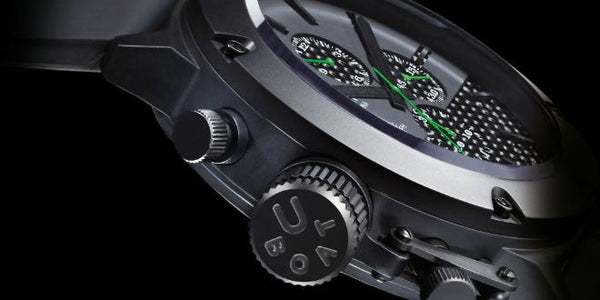
« Zenith celebrates the birthday of the first automatic chronograph movement »
Many buyers of mechanical watches today take it almost for granted that their new acquisition has automatic winding and doesn't need to be regularly recharged by hand. Yet until well past the middle of the 20th century, this was by no means the standard solution, even for simple three-hand watches, and automatic movements for chronographs have only been mass-produced for almost exactly half a century. We're taking the 50th anniversary of the El Primero as an occasion to look at the first automatic chronograph movement in watchmaking history.
Automatic watches: a new technology takes hold
Although self-winding mechanisms for pocket watches had already been developed in the final decades of the 18th century, they initially gained little traction on the market. The main reason was their price, which was considerably higher than that of models wound by hand via a crown. What's more, the crown was already seen as a noticeable advance over the keys that had previously been needed to wind movements.
Only with the arrival of the wristwatch did the question of how to avoid constant hand-winding arise once again.
Technically, a solution to the problem had been available since 1922 at the latest: that year, the French company Leroy produced the first wristwatch fitted with an automatic movement driven by an oscillating weight, though it ultimately never went on sale.


The British watchmaker John Harwood (1893-1965) had laid the technical groundwork for automatic watches with his pioneering inventions from 1914 onward. Harwood completed his first automatic wristwatch with an oscillating weight in 1923 and filed a patent for it in Switzerland on October 16 of that year, which the Swiss Federal Institute of Intellectual Property granted on September 1 of the following year. Series production of the automatic watches then began in 1926 through partnerships with two watch brands, Fortis and Blancpain. Five years later, Rolex introduced the Oyster Perpetual, the first automatic wristwatch with a unidirectional winding rotor, and patented the principle worldwide in 1932. At the time, however, the new solution was not yet suitable for chronographs, even though it was especially desirable in precisely that field.

After all, automatic winding doesn't just mean greater convenience for the wearer of a wristwatch – it also benefits timekeeping accuracy. That's because an automatic watch worn continuously reaches and maintains a relatively constant mainspring tension, whereas in a hand-wound mechanical watch the tension varies more over the course of the day.
The road to the first automatic chronograph movement
In the 1930s and 1940s, renowned watchmakers such as Breitling and Heuer steadily pushed the development of more precise and sophisticated chronographs. Yet there was still no alternative to manual winding. In 1946, Albert Piguet did develop a prototype of an automatic chronograph, but more than 20 years would pass before the first series-produced automatic chronograph reached the market. Several prominent watchmakers competed to be the first to present a production-ready automatic chronograph movement.
Breitling and Hamilton-Büren were working on such a project, as were Zenith and Movado, and Seiko. The race was finally decided on January 10, 1969, when Zenith unveiled its first automatic chronograph movement after two years of development, beating competitors who followed only a little later. To commemorate this milestone in watchmaking history, the manufacturer named the winning movement "El Primero" – Spanish for "the first." Today, 50 years on, the movement is still in production and remains the best-known of its kind.


Its reputation, however, rests not only on being the first automatic chronograph movement in series production but at least as much on its high build quality and performance. With a frequency of 36,000 vibrations per hour, it clearly outperforms comparable movements from other manufacturers.
Still sought-after 50 years later – thanks to a courageous, far-sighted workshop foreman
Fifty years of the El Primero is anything but a nostalgic look back at bygone days. The famous movement is still being made and has become an indispensable part of the collection of the brand with the star. That's far from a given: shortly after its launch, this mechanical masterpiece seemed destined for a brief existence, as ever-cheaper quartz watches produced in ever-growing numbers flooded the markets.
What good was an elaborately made and correspondingly expensive automatic chronograph movement when a quartz watch could do the same job not only far more cheaply but also with considerably greater accuracy? On top of that, at the end of May 1971 the storied Swiss watchmaker was sold to an American television and radio manufacturer from Chicago, whose management bet everything on quartz. In 1975, production of mechanical watches was halted altogether. In the process, the new leadership ordered all the tools and machinery needed to make the legendary movement to be disposed of.
So there would never have been 50 years of El Primero – had Charles Vermot, the foreman in charge of Workshop No. 4, not shown foresight and courage. Defying his superiors' orders, he decided not to scrap the tools required to produce the first automatic movement with a chronograph function but to keep them for the future. He managed to save around 150 presses along with numerous cams and small tools from destruction, stored them in an attic, and had the area walled up to protect his hiding place.
The 1980s: rebirth of a legend
Just a few years later, this would prove to be an incredible stroke of luck. Zenith had begun supplying movements to several other major brands in 1981, and in 1984 Rolex approached the company with a special request.


Rolex was planning to modernize the Rolex Daytona and fit it with the El Primero caliber. At the time, however, a single press cost around 40,000 Swiss francs, and since producing the coveted caliber requires more than 150 presses, an investment of roughly seven million francs would have been needed to fulfill the order. That would have far exceeded the available funds – but fortunately, there was still the equipment Charles Vermot had rescued. Nothing stood in the way of resuming production of the coveted movement after a break of almost ten years.
In the years that followed, Zenith itself returned to making mechanical watches and gave its historic caliber renewed prominence. In 1995, it could be admired for the first time through a sapphire caseback in the Chronomaster series. Shortly afterward, it was supplemented with a flyback function and with a tourbillon.
50 years of El Primero: the special editions
To honor the 50-year history of its world-famous automatic chronograph movement, the manufacturer came up with something special for the anniversary year: a collector's box containing three limited special editions of El Primero models.
Only 50 pieces of each of these special models exist. The first is a special edition of the 1969 chronograph, the first capable of measuring tenths of a second. The second is a special version of the new Chronomaster 2.0, and the third model in the "50 Years of El Primero" anniversary box is a Defy El Primero 21, which can even measure hundredths of a second.