« Unusual Scales and Functions on Watch Dials »
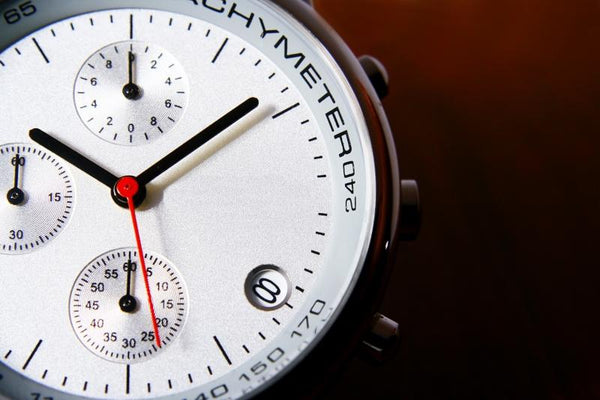
Alongside hour markers and the minute track, the dials of some luxury watches feature scales that have nothing to do with telling the time but can instead be used for specific measurements. A relatively familiar one is the tachymeter scale, often seen around the edge of the dial or on the bezel, especially on sports chronographs. Beyond that, however, there are various other scales whose purpose isn't always immediately obvious to the uninitiated. In this article, we introduce some of these "exotic" additional functions.
Calculating – Without Power or Batteries
A relatively well-known example is the slide rule function, as found on the famous Breitling Navitimer 01-46. Strictly speaking, this isn't a slide rule at all but rather a miniature circular slide rule. The principle, however, is the same in both cases.
 The only difference is that a slide rule works with two linear scales positioned one above the other, whereas a circular slide rule uses circular scales. In the case of the Navitimer, a pilot's chronograph designed specifically for the needs of pilots and flight navigators, the slide rule function was intended primarily for quick and easy calculation of flight times, distances, speeds, or fuel consumption. In principle, though, a slide rule or circular slide rule can be used for any kind of multiplication or division. Rule-of-three calculations in particular can be handled quickly and easily.
If you travel a lot and frequently need to convert exchange rates, for example, or regularly deal with non-metric units because of business in English-speaking countries, you'll soon come to appreciate this simple calculating aid – especially since, unlike a pocket calculator or a PC, it requires neither a power outlet nor a battery.
Telemeter: Measuring Distance by Sound
The telemeter scale, which is relatively rare today, should not be confused with the tachymeter scale. The tachymeter is used to determine speed, while the telemeter measures distance. To determine speed with a tachymeter, you need distance markers along the route traveled. The measurement is taken by starting the chronograph seconds hand at the exact moment you pass a marker – a mile or kilometer post, for example. If you then stop the hand as you pass the next kilometer post, the tachymeter scale shows your average speed over that stretch. If the hand stops at 40 seconds, for instance, this corresponds to an average speed of 90 kilometers per hour.
 The stopwatch function also plays an important role when using a telemeter scale, but the principle behind the measurement is different. It is based on the linear relationship between time and speed, whose product is distance. A telemeter scale can therefore provide information about the distance covered within a timed interval. This requires a specific speed as a reference value.
Telemeter scales frequently use the speed of sound as their reference, which under normal conditions is around 333 meters per second.
Telemeters based on the speed of sound were initially put to practical use mainly by the military. For example, the time difference between the muzzle flash of a cannon and the bang heard shortly afterward made it possible to determine how far enemy artillery was from one's own positions. The same principle also makes it easy to work out how far away a thunderstorm is from where you're standing.
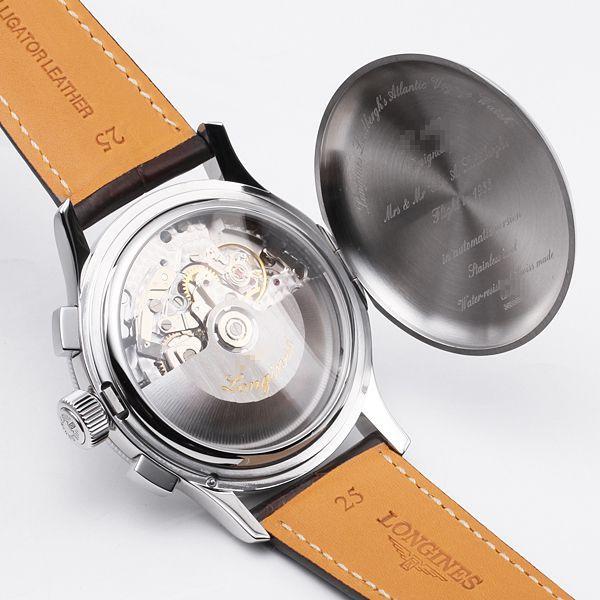
 One example of a luxury watch with this kind of distance-measuring function is the Longines Heritage Telemeter Chronograph. Although a modern self-winding chronograph movement, caliber 688, ticks inside, the model's retro design recalls the first two decades of the 20th century – a period in which wristwatches were increasingly catching on with both military and civilian users, and telemetric rangefinding still played an important role in the military, before losing significance in the following decades with the advent of other measuring methods, radar in particular.
A watch with a telemeter scale that has an entirely different look is the Junghans Meister Telemeter.
Hour Angle Watches for Pilots and Explorers
Another interesting function, which proved especially useful to pilots and explorers, was developed by Longines in collaboration with the American aviation pioneer Charles A. Lindbergh, who rose to fame above all for his first solo transatlantic flight in a single-engine airplane – the "Spirit of St. Louis" – in 1927. The result was a special wristwatch, also known as an hour angle watch, which made it considerably easier to quickly determine the current longitude when fixing a position.
Launched simultaneously in Europe and America in 1931, the instrument made it possible to read the so-called hour angle directly from the watch, once the central rotating auxiliary dial had been synchronized with a radio time signal. The principle behind this timepiece had been developed and patented by an American naval officer and navigation instructor named Philip van Horn Weems.
To this day, the Longines Lindbergh Hour Angle Chronograph remains one of the classics in the brand's collection and has been modified several times and produced in limited special editions.
No Electronics Required: The Mechanical Watch with Pulsometer
A rundown of scales on watch dials that are relatively rare today but nonetheless useful would not be complete without mentioning the pulsometer. A pulsometer is a scale that makes it easier to determine heartbeats per minute, since the measurement no longer has to be taken over a full minute, nor does the result of a shorter count have to be multiplied accordingly. A watch with a pulsometer is sometimes also referred to as a "doctor's watch."
Luxury watchmakers that have offered or still offer watches with a pulsometer include Girard-Perregaux, Longines, and Omega.
With the rise of smartwatches and fitness trackers, heart rate is now measured almost exclusively electronically, yet for fans of fine mechanical watches this function on a hand-wound or automatic watch still holds a special appeal – and for many a physician with an eye for fine watches, the pulsometer scale on the dial is an attractive yet understated status symbol.
 Pulsometer, Hour Angle, Telemeter – Usefulness Is in the Eye of the Beholder
Whether pulsometer, hour angle, and telemeter complications still serve a truly practical purpose in the original sense is open to debate. What is beyond dispute, however, is the sophistication these functions have allowed manufactures to lend their creations. With telemeter and hour angle watches, too, the fascination of the design is what counts, and the idea behind it alone gives them tremendous charm. But then, to some extent, that's true of every watch!