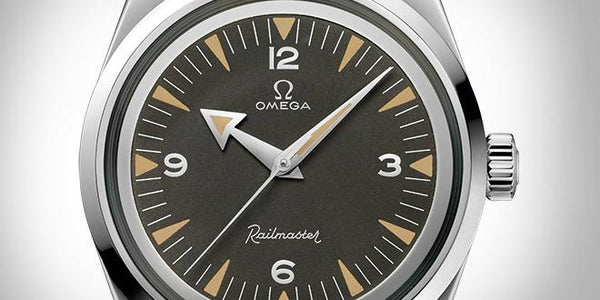
« Three Generations of Vintage Classics »
These days, the name Omega Dynamic means something only to watch historians or vintage watch enthusiasts. After all, it has been more than twenty years since the last watches bearing this name came onto the market – only to disappear again soon after. Yet at least some of them look surprisingly modern today and have retro fans dreaming of a reissue of these Omega classics. We take a look at a fascinating chapter of Omega's company history for our readers.
Omega Dynamic – the Wrong Watch at the Wrong Time?
Omega made three attempts to establish watch models under the name "Dynamic" on the market. Ironically, though, the models with perhaps the most "dynamic" name in the company's history saw sales that were anything but dynamic. The third and final generation in particular fell far short of expectations. Looking at the three generations today, you may find that hard to understand, because from a modern perspective the designs appear remarkably contemporary.

Perhaps the watches simply didn't suit the public's taste in their day but would be right on trend as a reissue? Either way, the Dynamic is certainly appreciated and happily worn as a vintage watch.
Retro Design with a Railroad Minute Track: The Third Generation
If you lay examples of all three generations of the Omega Dynamic side by side, you'll notice that the most recent generation looks the "oldest" in terms of design.
Its dial with the characteristic railroad minute track and the styling of its numerals, hands, and indices recall earlier military and pilot's watches. And indeed, the model draws its design from an Omega classic of the 1950s that is little known today: the RAF Pilots' Watch of 1953.
Unlike that watch, however, the third generation of the Dynamic, launched in 1997, was offered not only as a three-hand version with a date window but also as a chronograph. The latter features two subdials at 3 and 9 o'clock.
From today's perspective, it may well be the perfect vintage watch, and many manufacturers carry comparable models in their current collections.
All the more regrettable, then, that the model did not sell particularly well at the time and was presumably somewhat overshadowed by other Omega classics such as the Speedmaster or the Seamaster. The fairly sporty-looking watch had a sturdy stainless steel case and a bracelet of the same material, but was also available on leather straps. It was powered by the self-winding mechanical caliber 1138.
As is customary for military and pilot's watches, its hour and minute hands and hour numerals were generously coated with luminous material to ensure good legibility even in the dark.
Omega's First "Dynamic": An Award-Worthy Design to Start
In stark contrast to the nostalgic pilot's watch of the third generation, the first generation of the Omega Dynamic did not look back to the past but instead offered a design that was current for its time. Originally developed as Omega's entry in the competition for the City of Geneva prize in 1965, it went on sale in 1968. By the end of production in 1972, more than a million examples had found buyers. It was a mechanical three-hand watch with a date window at 3 o'clock, housed in a striking, slightly horizontally elliptical stainless steel case. Fans of 1970s design are likely to be positively enthralled at the sight of its dial.
The dial is particularly appealing graphically and delights the eye with accents such as a central seconds hand in light blue or orange, depending on the version, and a sunburst ring formed by the minute track and hour indices. Numerals were omitted without compromising legibility. The watch exudes a modern, understated elegance while also looking sporty and fresh. It was supplied with a stainless steel bracelet and a strap made of black Corfam, a particular type of synthetic leather. To ensure the strap was breathable, it featured perforations reminiscent of driving gloves. A strap-changing tool, also included, made swapping straps effortless.
When developing the first Dynamic, however, Omega's designers placed great emphasis not only on an attractive yet functional look but at least as much on an ergonomic shape that conforms perfectly to the wrist and provides excellent wearing comfort. Should Omega decide to reissue this model at some point in the near future, it could surely count on a warm reception from retailers and, above all, watch enthusiasts.
Original, Brilliant, or an Acquired Taste? – The Second Generation of the Dynamic
That would probably be less certain for the second generation, launched in 1984. In terms of both design and technical specifications, it is a typical product of its time. All in all, at first glance you would probably take these models for a Swatch rather than a piece from Omega's collection. That speaks neither against the watch nor against either manufacturer; rather, it shows that the Swiss watch industry in particular was going through a period of reorientation in the mid-1980s.
This had been triggered by the quartz crisis, and for many manufacturers it went hand in hand with exploring new paths – in both the design and the technology of their watches.
Not all of these attempts were successful, and from today's perspective many of them are no more than small, sometimes interesting, but rarely defining anecdotes in watch history. That is more or less true of the second Dynamic generation as well. It was based on a very modern-looking modular concept intended to make switching between different straps easier. To this end, every strap, regardless of material, had an integrated metal ring into which the watch case was inserted and secured from below with a second ring and a kind of bayonet lock. Each watch came with a special tool for tightening and releasing the retaining ring.
The design of the case and dial still echoed the first generation, but without achieving its captivating effect. Instead of an automatic movement, it was powered by the ETA quartz caliber 1430. As the product of an obvious period of soul-searching at Omega after the difficult years of the quartz crisis, the second Dynamic generation met with limited success, and production was discontinued after only a few years.
Too Dynamic for Major Market Success?
The fact that the third generation of the Omega Dynamic, described at the beginning, sold the fewest examples is likely to have sealed the fate of this somewhat ill-starred model line.

Although the price was quite affordable and the retro design was coherent, fewer than 8,000 pieces are said to have been sold in total. And so the Dynamic remained just an episode in the history of a company that has repeatedly proven, with models such as the Speedmaster, the Constellation, or the Seamaster, that it is perfectly capable of creating true icons of the luxury watch segment.

Yet it is precisely the comparison with an Omega classic like the Speedmaster and the legendary Moonwatch that emerged from it that offers a clear clue as to a key reason for the Dynamic's poor reception. Three fundamentally different watches within three decades were evidently too many to position credibly on the market under one and the same model name. A more cautious and continuous evolution might have been the better approach.
Those hoping for a reissue of the Dynamic, which is currently only available as a vintage watch with a good deal of luck, can take at least some hope from several Omega revivals in recent years, be it the "1957 Trilogy" presented at Baselworld 2017 or the 1969 Seamaster Bullhead, which has likewise been brought back to life. So it's quite possible that Omega will one day give the Dynamic a second life too – and that its sales will then live up to the manufacturer's expectations.