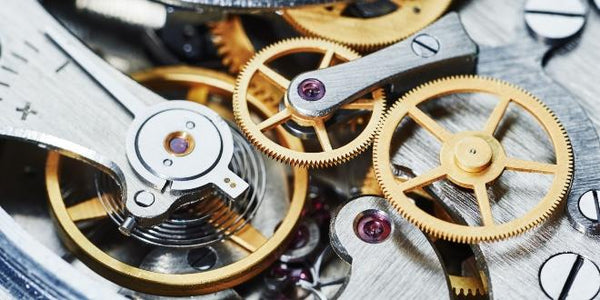
"Non-variable, non-oxidizing": For more than 80 years, Nivarox has been regarded as the best metal alloy for making hairsprings. Invented in 1933 as an answer to the imprecise properties of earlier materials, it stands out for its excellent temperature stability, elasticity, and durability. To this day, the exact composition of this widely used material remains a secret known only to the Swatch subsidiary Nivarox-FAR.
The Genius of Dr. Straumann
The material's backstory goes all the way back to 1675, when Dutch physicist Christiaan Huygens designed the world's first balance spring. It greatly improved the regularity of mechanical movements, but it also set off a centuries-long process of refinement. While early pioneers such as Abraham Louis Breguet concentrated on the shape of the gossamer-thin spring (think Breguet overcoil), later engineers turned their attention to the material. Because even with the best geometry, it became clear that the steel originally used, mostly unalloyed, was highly prone to rust and lost its elastic force as temperatures rose. That made inaccuracy inevitable.

A first attempt at a solution came in 1919, when the French-Swiss Nobel laureate in physics Charles Édouard Guillaume patented the material Elinvar (élasticité invariable). But the innovative alloy of steel, nickel, and chromium soon proved too soft, which led to imprecision due to low balance amplitude. It wasn't until 1933 that Swiss watch technician and precision engineer Dr. Reinhard Straumann (1892-1967) achieved the decisive breakthrough: His Nivarox alloy remains the favorite in watchmaking to this day and shines with a range of valuable properties for balance springs. Not only its high robustness and stable rate, but also its strong resistance to magnetic fields account for the material's superiority over earlier alloys.

The Secret of the Composition
Although Straumann's basic formula can be read in the corresponding patent, he kept key details of the composition under wraps. Those details are known today only to the Swiss company Nivarox-FAR. The Swatch subsidiary is by far the most important maker of hairsprings and (understandably) is unlikely to have any interest in publishing the material mix. Nevertheless, most of the secret is known today, because researchers have managed to produce near-perfect replicas of the material over the past decades. It contains not only the classics steel and nickel, but also titanium, beryllium, cobalt, molybdenum, and tungsten.

Temperature Coefficient: Where the Material Excels
A look at its temperature coefficient shows why this alloy is so good. It is a key figure for balance springs, indicating their rate deviation as a function of external temperature fluctuations. The ideal would be a temperature coefficient of zero seconds, meaning a perfectly isochronous movement unaffected by outside influences. Classic hairsprings made of steel or bronze are far from that: Here, a drop in outside temperature of just one degree Celsius can cause a rate deviation of ten seconds per day. Straumann's material, by contrast, achieves a temperature coefficient of about 0.5 seconds per day, making it roughly twenty times (!) as precise as conventional hairsprings. Now that's saying something.

Which Watches Use This Innovative Material?
Ever since the superiority of the Nivarox alloy became known, continuous development has lowered production costs and thus made it highly suitable for mass production. As a result, not only luxury watches but also entry-level mechanical models can benefit from the material's advantages. Just how widespread the alloy is in watchmaking is illustrated by the enormous market power of the large-scale producer Nivarox-FAR: Founded in 1984 and now part of the Swatch Group, it supplies more than 90% of the Swiss watch industry with its delicate components and can be considered a de facto monopoly. What at first sounds like a lack of competition, and therefore rather unfavorable, is in fact a win-win situation: Long experience and complete knowledge of Straumann's invention allow the manufacturer to produce these advanced balance-and-hairspring assemblies extremely cost-effectively.
Replacement by Silicon: Only a Matter of Time
As excellent as the properties of the metal alloy may be – the future does not belong to it. Two decades ago, it already had to cede its pioneering role to the metalloid silicon, which surpasses nearly all the advantages of the Nivarox alloy. Temperature coefficient? Lower. Stability and elasticity? Higher. Protection against magnetic fields and shock resistance? Even better. Until a few years ago, however, these advantages were irrelevant, because silicon hairsprings required a far too complex manufacturing process and only a few luxury watches – such as the Ref. 5350 from manufacture Patek Philippe in 2006 – were fitted with them. But times have changed. Today, around 90% of Patek Philippe's mechanical watches feature a silicon hairspring, and the innovative invention is making its way into ever lower price segments.
While Omega's Co-Axial models such as the Moonwatch Co-Axial, Seamaster Aqua Terra Co-Axial or De Ville Prestige Co-Axial were the most affordable route to silicon just a few years ago, the material has since arrived in the three-digit price range. The best example is the Tissot Gentleman Powermatic 80 Silicium: Alongside the advantages of its hairspring, it offers an 80-hour power reserve at a manufacturer's price of €790.


In doing so, it sets the tone for future materials in watchmaking: Straumann's patent will gradually disappear as new developments take its place. The era of the metal hairspring is drawing to a close. Not only silicon, but also other ideas such as synthetic diamond or the glass-ceramic material Zerodur will accelerate this process. Enthusiasts can therefore look forward to a world of watches that will be more precise and more advanced than ever before.