When masterpieces feature it, watch connoisseurs applaud. Behind this unassuming function, which caused a sensation when it debuted, lies sophisticated manufacture craftsmanship. Flyback watches are still being designed today because their fascination is timeless and they testify to the expertise of the brand behind them.
A Groundbreaking Invention: Restarting on the Fly
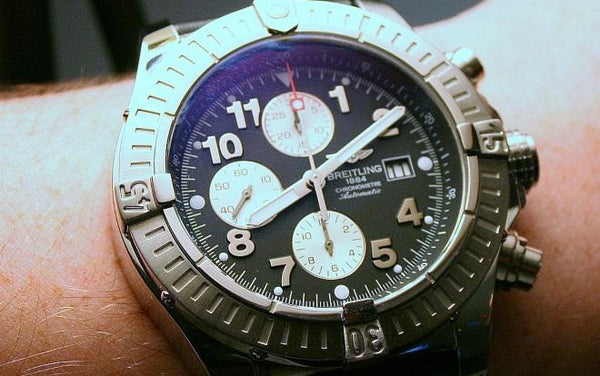
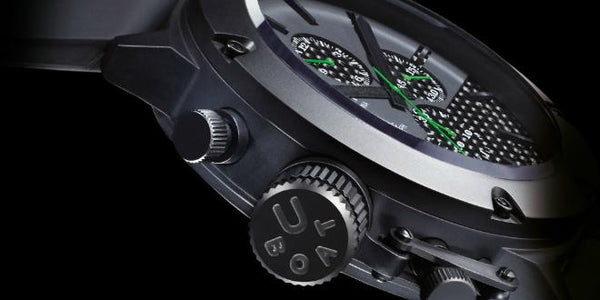
Chronographs are precision tools for measuring how long an event lasts. This stopwatch function mainly enhances wristwatches developed for professional or sporting purposes. The flyback mechanism optimizes handling: these special models have two pushers for timing an interval. The one at 2 o'clock starts and stops the measurement. The pusher at 4 o'clock resets the hands to their starting position.
Flyback watches allow an alternative use of the second pusher: if you press it while a measurement is running and hold it down, the seconds hand snaps back to its starting position. Now all you have to do is take your finger off the pusher and the next measurement begins. The flyback function is also known as "fly-back reset" or "retour-en-vol." If you prefer something more contemporary, you could explain this functional feature to a layperson with the term "reset."

Efficient Operation When Timing
Anyone who sees a wristwatch not just as a style statement but uses it as an instrument in sports or at work will recognize the advantage: if you want to restart a measurement or begin the next one immediately, three actions are normally required. Stopping is followed by resetting to zero and starting the next count.
With the mechanical stopwatches once used at sporting events, operation is intuitive. The stopwatch rests in one hand, with your fingers hovering over the pushers for quick reactions. It gets more awkward when you have to reach across to the other wrist and press small pushers three times in the correct order. When every second counts, you'll appreciate efficient flyback watches: they combine three steps into a single action that you can perform without even looking at the watch.
Greater Safety and Accuracy Thanks to the Flyback Reset
No sooner had the first flyback watch been invented than it accompanied Richard Byrd, who in 1929 became the first to fly over the South Pole. Anyone familiar with the conditions of early aviation will understand his enthusiasm. Wrist-worn cockpit watches were important navigation instruments. For example, pilots would start the chronograph on sighting a prominent landmark in order to plan the rest of the flight safely.

On long-distance flights, intervals had to be timed several times. Even if the three steps needed to reset were carried out as quickly as possible, the seconds lost in the process added up. Anyone who failed to factor this in risked navigation errors that could be fatal at high airspeeds. Missing the destination or misjudging the fuel reserves were real possibilities. Professional aviation pioneers accounted for these discrepancies with complicated calculation methods. These became simpler when the flyback function made its debut. The same applied to measurements in science or the military that demanded precision to the second.
The Spark: Longines' Patent
The pioneering work was done by the Swiss brand Longines, which in 1925 introduced a flyback watch that won praise from pilots. Around ten years later, it patented the function that characterized the legendary L13ZN caliber. After all, this was a horological milestone with a new movement design:
Conventional construction dictates that the relevant movement component must be disengaged when the chronograph, i.e., its hands, is returned to zero. If it remained engaged, damage would be inevitable. Longines succeeded in integrating a mechanism that disengages and re-engages the clutch for the reset process in an instant. It is the heart of the flyback function, which ranks among the demanding complications.

Refining Brilliant Ideas - Blancpain Fifty Fathoms
One brand brought the additional function back in 1996 and still cultivates it today - for example with the Blancpain Fifty Fathoms Bathyscaphe Chronographe Flyback. It shows that the complication is also practical for diving, provided the manufacture masters one challenge: the more controls there are, the trickier it is to keep out the elements. The mission was accomplished with the black Blancpain Fifty Fathoms Bathyscaphe Chronographe Flyback, featuring 300 m water resistance, a ceramic case, and a sailcloth strap.
Watch History You Can Experience - Chopard L.U.C. Chrono One Flyback
The flyback is often seen as a tribute to watchmaking tradition. The Chopard L.U.C. Chrono One Flyback is a prime example. For an authentic homage, the premium manufacturer departed from its preference for gold with this limited edition. The automatic chronograph embraces a titanium alloy, a material that plays a role in aviation. In this way, the watch's design builds a bridge to aviation, the very field for which the flyback function was developed. The khaki dial and light brown leather strap enhance the vintage charm.

A Breath of Fresh Air for a Proven Classic - Hublot Big Bang Unico Gourmet 42 mm
The luxury brand based in Nyon only debuted in 1980. By then, the importance of the flyback function had long since diminished. Ambition and a love of high-contrast design are behind the idea of treating the colorful Hublot Big Bang Unico Summer Purple 42 and the Unico Gourmet to this complication. It proves that unconventional approaches and traditional craftsmanship are not mutually exclusive. The same goes for the chronograph movement inside: with its double clutch system and the column wheel visible on the dial side through the openworked dial, it stands out from the ordinary.


Far from Extinct - Flyback Chronographs
Aviation, research, or professional sports: measuring instruments that outperform mechanical flyback wristwatches in accuracy and functionality have long existed. Apart from a brief pause during the quartz crisis, this additional chronograph mechanism has nevertheless endured. If you have a soft spot for it, ambitious watchmakers offer a wide variety of options, for example:
- Audemars Piguet Code 11.59 Ultra-Complication Universelle (RD#4)
- Breguet Type 20 Chronographe 2057
- Frederique Constant Chronograph Manufacture flyback watches
- Hublot Big Bang Unico Summer Purple 42 special edition
- Hublot Big Bang Unico Gourmet 42 mm
- Longines Spirit Flyback
- Patek Philippe 5935A World Time
- Raymond Weil Freelancer Pilot
- Rolex Yacht-Master II regatta watch
- TAG Heuer Monza flyback watches
- Zenith Pilot Big Date