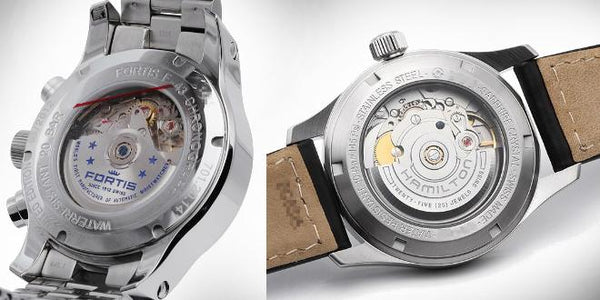
A fashion watch here, a luxury watch there, and both powered by the ETA 2824-2? The catch: the world-famous movement maker offers different quality grades so its products fit the pricing strategies of a wide range of clients. Luxury brands such as Hamilton, Fortis or Zenith also refine ébauches, so that notable differences define their collections.
Quality Differences in the Mecaline Collection
Fashion jewelry labels and prestige brands have one thing in common: when they want to upgrade their collections with a chronograph, they set their sights on the caliber 7750. The quality grades under consideration, depending on brand identity, make for considerable differences, however. In principle, ETA groups the caliber quality of its mechanical movements as follows:
Standard and Elaboré movements have jewels made of polyruby, Nivarox 2 hairsprings and a gilded nickel balance. Standard movements are regulated in two positions, with an average rate deviation of +/- 12 s/d. Elaboré movements are adjusted in three positions and have rate deviations of +/- 7 s/d. In ordinary watches, both versions are a mark of quality, as the experienced manufacturer places great value on solid products.

Exclusive brands, however, use only ETA movements in the Top and Chronomètre grades. These feature red ruby jewels, an Anachron hairspring and a gilded Glucydur balance. Both premium movements are adjusted in five positions. The Top line achieves average rates of +/- 4 s/d. As the name suggests, Chronomètre movements undergo an elaborate accuracy testing procedure and have earned chronometer certification.
Red Ruby and Other Material Differences
Traditional Swiss brands, for example, deliberately choose the ETA 2836-2 in the Chronomètre and Top grades. The rubies in all product lines are synthetic corundum, used to reduce friction and, in turn, wear on the moving parts of the movement. Red ruby is preferred for calibers in the Chronomètre and Top grades because it has smoother surfaces. Its rich color is also more attractive than polyruby, which suits watch designs with a sapphire caseback.

The copper alloy Glucydur is harder and more durable than nickel. The same applies to the alloy Anachron, which is also less susceptible to magnetism than Nivarox 2. That is why ETA partly boosts caliber quality with these materials. The number of positions is also relevant to quality. Put simply: the more adjustment options a movement's grade allows, the smaller the positional errors and, consequently, the rate deviations.
Support That Traditional Brands Know How to Use
You design a fine watch case, order the ETA 2892-A2 in one of the high-end grades, later fit it into the prepared case and add a handsome strap – and the luxury collection is done. Skilled watchmaking isn't that simple. Even complete movements usually arrive as kits, because watch manufacturers want to realize their own functional and aesthetic design ideas.

Modified Ébauches
Ambitious brands prefer the raw movement – known in the trade as an ébauche. It is delivered incomplete so that, besides the escapement, hairspring, balance, mainspring and hands, the dial can also be influenced. It is also common for watch brands to order modified special movements or to develop a new release together with the movement maker. This scope shows that ETA caliber quality defines the quality of a wristwatch less than the expertise of the watch manufacturer does.

ETA 2824-2: A Perennial Favorite Across Many Grades
The ETA 2824 was introduced in many quality grades as early as the 1970s and became a bestseller. The same goes for the revised version, which has been popular since the 1980s. The robust and precise 2824-2 automatic movement features 28,800 vibrations per hour (4 Hz), Incabloc shock protection, a bidirectionally winding central rotor, 25 jewels and a date window. Its typical power reserve is 42 hours.
Breitling's caliber 17 is known to be a modification of the proven ETA caliber, although the brand significantly refined its quality for this in-house movement. Tissot developed the Powermatic 80 (ETA C07.11) together with the movement maker on the basis of the 2824-2. It features a silicon balance spring and an 80-hour power reserve. Hamilton drew inspiration from this ETA 2824 evolution for its H-10 in-house caliber.

ETA 2836-2: A Best-Value Hit Across Many Grades
Since their debut in 1982, these ETA movements have been in demand in many quality grades because, along with 25 jewels, a ball-bearing rotor, Novodiac shock protection and a reserve of around 42 hours, they offer plenty of additional functions. As standard, the ETA 2836-2 has day and date displays. If desired, it can easily be equipped with a GMT function. Tissot and Oris, for example, have used these attractive calibers. When it came to quality grades, these premium brands – valued for their excellent product philosophy and their soft spot for moderate budgets – surely reached for the stars.
ETA 2892-A2 – Ideal for Slim Watch Design Across Many Grades
2892-A2 movements have been widespread in all quality grades since 1975 – especially the high-end versions. In 1984 the second edition took the place of the 2892, and in the 1990s the 2892-A2 variant joined the lineup. Although the quality of this ETA caliber's automatic winding is often criticized, it is successful thanks to its slim construction. This suits elegant wristwatches well and makes it easier to add complications.
The compact caliber has a date display, 21 jewels and typically a 50-hour power reserve. The related 2893-2 scores with a second time zone or 24-hour hand. Fortis and Zenith, for example, have used these ETA movements in grades for discerning standards. Omega even relied on them for some Seamaster Diver references.

Chronograph Caliber 7750 – The Gateway to the Chronograph Across Many Grades
While automatic movements established themselves early in classic wristwatches, manual winding long remained common in chronographs. One reason for the delay was that, at first, no ETA movements were available in convincing quality grades. In the 1970s, the ETA 7750 – also known as the Valjoux 7750 – finally made its debut.
Since then, the automatic chronograph movement has been firmly established in the watch world. This ETA caliber is valued for its quality, reflected in its robustness, reliability, 54-hour power reserve and adaptability. Typical of the ETA Valjoux 7750, alongside the day-date display, is the arrangement of the sub-dials, which forms an upright triangle. Brands such as Breitling and TAG Heuer have used this movement.

Not All Manufactures Rely on Third-Party Calibers
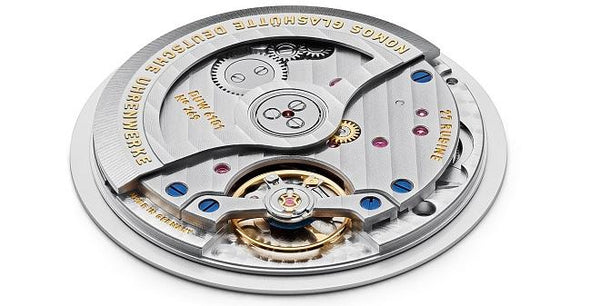
Although luxury brands from Breitling to Omega to Tudor like to use ETA movements of the highest grade, not all watch manufacturers are open about it. Breitling, on the other hand, specifies its cooperation with ETA, Sellita or Dubois-Depraz for all third-party movements. And of course, with brands like Rolex or Hublot you expect more exclusive in-house movements in most cases. One of the few manufactures that prefer their own movement portfolio over ETA components is Nomos. The company favors its own movement portfolio and uses only in-house mechanical calibers.

Zenith is similarly ambitious, as reflected in its remarkable 5 Hz in-house movement "El Primero".