« What Does Diamond-like Carbon Mean? »
Eternal youth for your luxury watch: DLC coatings promise lasting resistance to wear and a smooth, pleasant surface. But how does the coating actually work? Today we explain the basics of the method, how it relates to the PVD process, and what advantages and drawbacks it brings. We also present popular luxury watches in various price ranges that benefit considerably from the carbon coating.
The PVD Process: The Foundation of DLC Coating
The abbreviations DLC and PVD are widespread in the watch world. They are often mistakenly used interchangeably, even though they mean different things. PVD stands for "Physical Vapour Deposition" and refers to a process in which a vapor of tiny metal particles is created. Common materials are titanium nitride (TIN) and zirconium nitride (ZrN). To prevent the atomized metals from reacting with air, the entire process takes place in a vacuum chamber. Its internal temperature is kept at moderate levels between 100 °C and 360 °C, because the watch case to be coated sits in the vacuum chamber alongside the metal vapor and must not deform. The core of the PVD process is simple: the vaporized metals condense on the surface of the watch case and form a protective film roughly 5 micrometers thin. Unlike electroplating, another method for increasing durability, no chemical reactions take place.

DLC coating, on the other hand, stands for "Diamond-like Carbon" and refers to one of the possible materials (as an alternative to titanium nitride and zirconium nitride) that can be used in the PVD process. Put plainly: no DLC without PVD. In German, the material would be called "diamantähnlicher Kohlenstoff" or "Kohlenstoff mit Diamanteigenschaften" – carbon with diamond-like properties – which aptly describes the character of the coating.
Black Looks, High Durability: What Makes Diamond-like Carbon Special
Once a watch has been DLC-treated, its hardness – measured on the Vickers scale – rises considerably. For context: a diamond reaches 10,060 Vickers, while gypsum, which you can scratch with a fingernail, comes in at 36 Vickers. The difference between regular stainless steel and the treated version is interesting: while the bare alloy reaches only 200 to 600 Vickers depending on its composition, the value climbs to as much as 3,000 Vickers with DLC coating. That explains why ordinary steel watches show a multitude of small scratches after a few years of wear, while coated versions still look as good as new. Incidentally, applying the protective carbon film is not limited to the watch industry: surfaces are DLC-treated in aircraft construction, car wheels, medical technology, and many other fields.

Pros and Cons of the Method
Dive watches, sports watches, and other outdoor watches in particular benefit from the increased resistance that comes with carbon coating. While it isn't as hard as diamond, it can multiply the hardness of the surface and increases the likelihood of enjoying a flawless look even after intensive use over long periods. Speaking of looks: the typical black aesthetic of coated watches is especially popular on sports watches, because it sets them apart from the crowd while delivering a cool, masculine look. But it's not only men – female watch enthusiasts, too, increasingly appreciate the dark, mysterious aesthetic of the coating. Another selling point is how it feels: much like ceramic, the treated surface feels smoother than conventional stainless steel and sits especially gently on the skin. Compared with electroplating, the main alternative to the PVD process, Diamond-like Carbon is less expensive to apply and relatively eco-friendly, since it avoids chemical reactions.

A key drawback of the process comes into play if a scratch does occur after all. In that case, spot repairs are not possible; instead, the coating has to be stripped completely. That solution is laborious, costly, and can reduce the surface quality of the watch case. This is where ceramic cases have a clear advantage. In addition, DLC coating adheres poorly if other finishes have already been applied beforehand. If the requirements are met, however, a watch can be DLC-coated after the fact, which, besides the desired durability, above all creates a distinctive look. You should budget around €2,000 for a top-quality coating. Removing it without residue is considerably cheaper at roughly €300.
Notable Watches with This Durable Treatment
1.) Breitling Superocean Automatic 46 Blacksteel
A monster of the deep: what the sperm whale is to the animal kingdom, the Breitling Superocean Automatic 46 Blacksteel is to the world of watches. The combination of Diamond-like Carbon and a 46-millimeter diameter makes this giant look every bit as imposing as it really is, paired with phenomenal water resistance to 2,000 meters – exceptional even by Breitling standards. Large Arabic numerals with generous luminous coating underscore the uncompromising focus on functionality. A domed sapphire crystal with anti-reflective coating on both sides, a screw-down crown with two gaskets, and a solid stainless steel caseback make its incredible robustness possible. Thanks to the non-manufacture caliber 17, the model is also more affordable than most of the luxury brand's other divers.

2.) Chopard Mille Miglia GTS Automatic Speed Black
Stylish diving in dark attire: although the Chopard Mille Miglia GTS Automatic Speed Black is a clear homage to the world's most famous 1,000-mile classic car race, its focus lies on deep-sea capability. This limited edition of 1,000 pieces boasts an impressive 1,000 meters of water resistance, while red accents add a fiery touch to the dominant black of the 43-millimeter Geneva luxury watch. Strap, dial, case – darkness reigns here. Precision doesn't fall short either, as the COSC-certified automatic movement 01.01-M with a 60-hour power reserve demonstrates.

3.) Junghans Meister Pilot
In reference 027/3794.00, the Junghans Meister Pilot offers a powerful sportiness rarely seen from this otherwise elegant, long-established Black Forest company. While the aesthetic is defined by the angular rotating bezel and the refined gradient of the dial, proven precision reigns inside the 43.3-millimeter stainless steel case, which is water-resistant to 100 meters. Besides the time, the automatic caliber J880.4 drives a chronograph function whose restriction to two subdials ensures stylish symmetry.

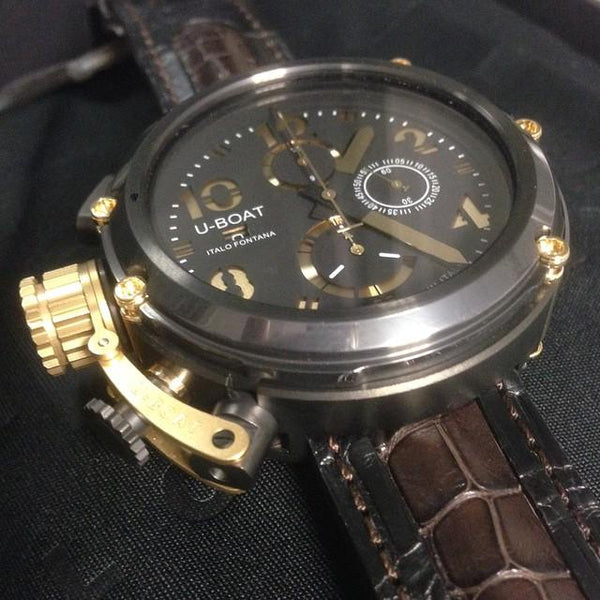
4.) U-Boat Capsoil DLC
If you prefer the exotic, you should get to know the U-Boat Capsoil with the suffix “DLC” in its name: designed by Italo Fontana, arguably Italy's most creative watch designer, this luxury watch offers not only a black case but, above all, an incredibly intense black on the dial, achieved by filling it with oil. The fill is not complete, leaving an air bubble to drift casually over the huge numerals of this extravagant model as you wear it. No question: here, the DLC coating becomes a side note.