« Horizontal or Vertical Makes a Difference »
Connecting the chronograph seconds hand to the movement requires a clutch. There are two types, horizontal and vertical, and they work in fundamentally different ways. But where exactly do the differences lie, and what are the advantages and drawbacks of each?
The Chronograph – An Invention from Napoleon's Era
Given how elaborate a chronograph's construction is, you would hardly guess it, but as early as the beginning of the 19th century the pioneers of watchmaking were already capable of building watches with this function.
Louis Moinet is considered its inventor: In 1816, the Frenchman – who, incidentally, worked for many years with the even more famous Abraham Louis Breguet – created the so-called "compteur de tierces," which beat at 216,000 vibrations per hour and featured a reset-to-zero function. His alarm clocks and astronomical clocks, as well as his famous watchmaking textbook "Traité d'horlogerie," also made Moinet a true giant of horology.
Demanding Precision Work: The Horizontal Chronograph Clutch
He and many of his contemporaries relied on the horizontal chronograph clutch, a technique still used today by manufactures such as Girard-Perregaux and Breguet. It gets its name from the fact that the wheels involved lie on the same plane. These include the chronograph center wheel, whose arbor carries the chronograph seconds hand, the driving wheel, and a so-called intermediate wheel (often also called the coupling wheel).


In a chronograph, the arbor of the seconds hand has a rearward extension carrying the driving wheel, which is connected to the chronograph center wheel when needed – that is, as soon as the wearer activates the stopwatch function. From that moment on, power is transferred from the seconds hand to the chronograph seconds hand. The problem: If there were only these two wheels, they would always turn in opposite directions. The solution is the intermediate wheel, which carries no hand of its own and, as the name suggests, sits between the driving wheel and the chronograph center wheel. Normally, it runs continuously along with the regular seconds hand. When the timer is started, a coupling lever moves and brings the intermediate wheel into mesh with the chronograph center wheel.


Watch enthusiasts especially appreciate its looks: All the components are on display, creating a beautiful sight. The catch, however, is the extreme level of fine adjustment required. Both the swing range of the coupling lever and the spring that holds the chronograph hand in place after stopping (which is what makes it possible to read the measured time in the first place) must be adjusted with pinpoint accuracy. Wear on the wheels caused by engaging the clutch and possible inaccuracies in the recorded time are further drawbacks of this mechanism.


The Vertical Version – Smooth and Efficient
In 1936, the Swiss manufacturer Pierce became the first to eliminate most of these difficulties. The solution, now generally regarded as the technically superior design, is the vertical chronograph clutch: Here, the wheels are not arranged side by side but stacked on top of each other. Mounted on a cylindrical center, the lower wheel turns constantly and is permanently connected to the seconds wheel. Likewise, the upper wheel always rotates as well, but is connected to the chronograph center wheel.
Important: In their normal state, the two wheels are not connected to each other.
When you start the chronograph, a disc (firmly attached to the upper wheel) is pressed onto the lower wheel by a spring; static friction creates a positive connection. When the chronograph is stopped, the two are separated by a pincer that pushes the connecting disc back up.


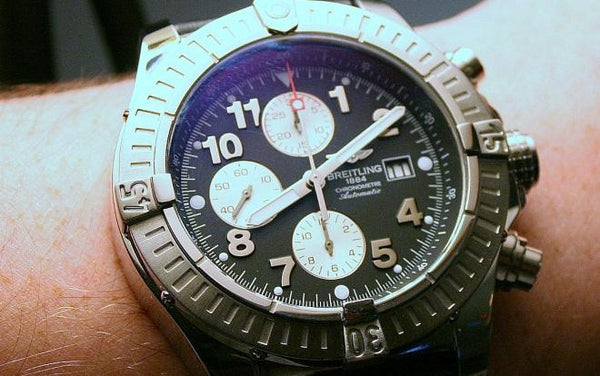
As a result, unlike with the horizontal clutch, no tooth can press against the tooth of another wheel. This makes it impossible for the chronograph seconds hand to jump at the start, and it also significantly reduces friction and wear. It is with good reason, then, that renowned movements such as the Omega Caliber 9900, the Breitling Caliber 01, and the Rolex 4130 rely on the vertical chronograph clutch.
What Matters in a Chronograph
That said, you definitely cannot speak of a fundamental superiority of the vertical version: Both types of chronograph clutch can be made at very different levels of quality, and some horizontal designs rank among the finest chronographs in the world. Other criteria, such as the extent of handcraftsmanship or in-house production, are more telling here. Especially with manufacture watches, which usually come with a high price tag, you can expect such a level of perfection that the question of a horizontal or vertical chronograph clutch no longer matters.


For many watch enthusiasts, a more interesting question is whether it is a flyback chronograph: Models with this function can stop, reset to zero, and start a new measurement with a single push of a button. This is particularly useful for pilots or race car drivers, since it allows them to time legs or sections of a course.


When choosing a chronograph, additional functions are therefore an exciting consideration: They extend what the ordinary chronograph seconds hand can do, and sometimes they simply look good. Take the tachymeter scale, for example: Found on many watches such as the Tag Heuer Formula 1, it lets you read average speeds instantly. You start at a specific marker, cover one kilometer, and stop the chronograph – a tachymeter chronograph also comes in handy in military use or when you want to know how far away a thunderstorm is. Admittedly, the scale often simply embellishes the masterpiece and looks professional – without ever being used.
Quartz Watches – An Alternative?
Whenever chronograph clutches come up, the discussion is always about hand-wound or automatic watches. Compared with other mechanical watches, and especially with quartz watches, these are more complex, which usually goes hand in hand with high prices – even without any handcraftsmanship involved. Wouldn't quartz watches be an excellent solution, then? After all, they are considerably cheaper than their mechanical relatives. And which automatic watch can time events to a tenth of a second?
The question of quartz chronographs pits functionality against fascination: Although they are generally more accurate and more attractively priced, they fail to spark enthusiasm among many watch lovers.
They lack that admirable inner life and the centuries-old tradition, and, to put it bluntly, they are simply a battery-powered device like a cell phone or an alarm clock. Even so, quartz watches have a loyal following too – so whether they are an alternative to mechanical timepieces is a matter of principle. Much like the choice between horizontal and vertical clutches.